In short: An addiction treatment center marketing plan starts from the admissions you need, not the budget you have. Work back from your census goal and your cost per admission to pick the channels (SEO, local search, certified ads, referrals), fix intake so inquiries turn into admissions, and judge every channel by the admissions it produces.
Marketing a drug rehab has a reputation problem. For years, the industry was known for call centers posing as local programs, paid referrals and ads that promised recovery in thirty days. Google responded by restricting addiction treatment ads. Regulators responded with federal law. Families responded by trusting almost no one.
That history is also the opportunity. A treatment center that markets honestly, shows up where families search and answers the phone quickly now stands out. This guide shows how to build an addiction treatment center marketing plan step by step: the rules it has to follow, the targets it starts from, each channel, intake, measurement and who should run it. It applies to detox, residential, PHP, IOP, outpatient, sober living and dual diagnosis programs, and every statistic links to its source.
What a treatment center marketing plan is for
A drug rehab marketing plan is the written plan for how your treatment facility helps people who need care find it, trust it and contact it: which channels you use, what each one should produce and how you measure it. The same plan works for detox centers, residential programs, outpatient recovery centers and dual diagnosis programs.
The goal is not clicks or calls. The goal is appropriate admissions: people whose needs match your level of care, your clinical capability and your payer mix. Every decision in this guide comes back to that number.
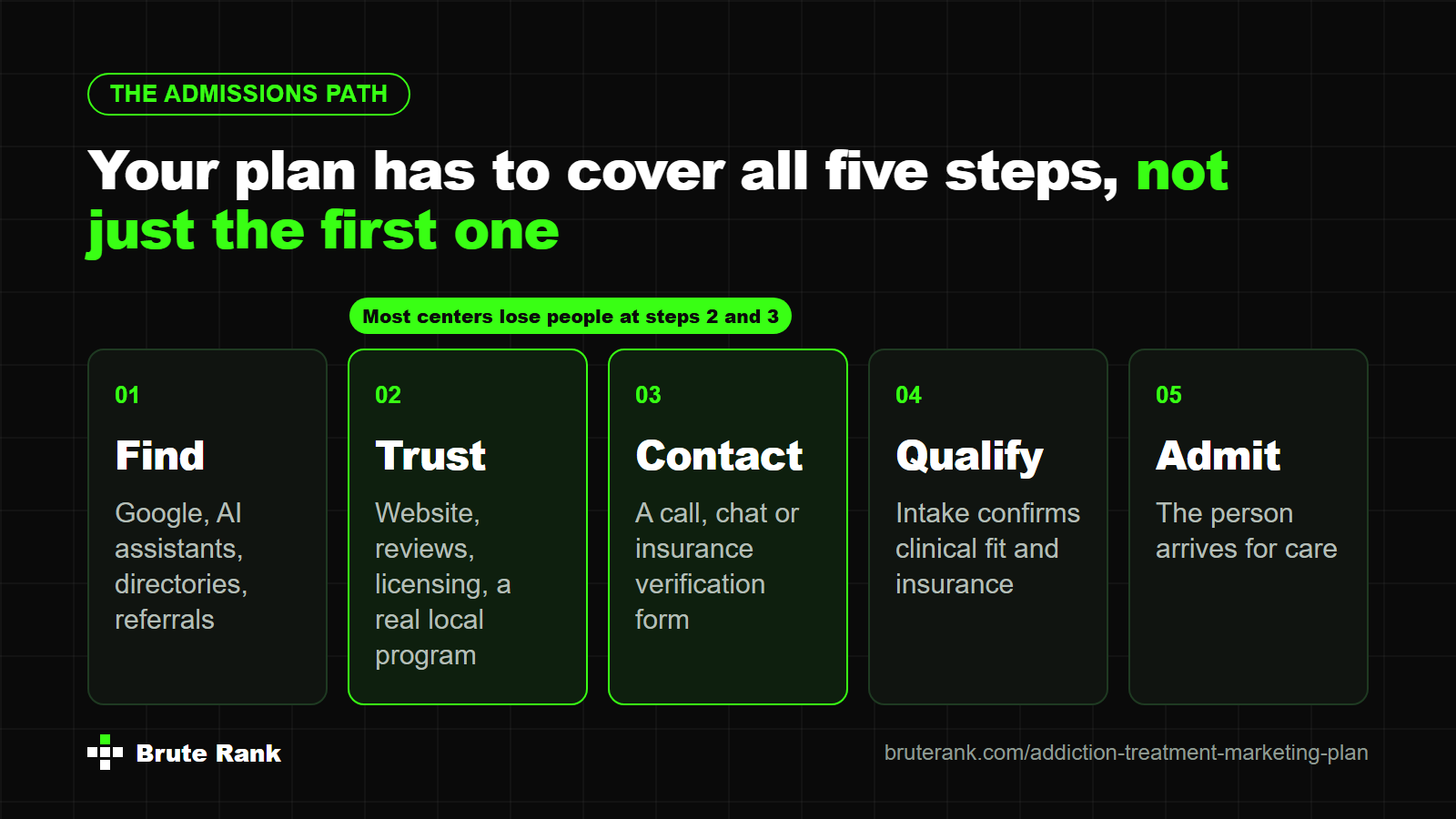
The five steps your plan has to cover
- Find: a person or family searches Google, asks an AI assistant, checks a directory or gets a referral.
- Trust: they judge your website, reviews, licensing and accreditations, and whether you look like a real local program.
- Contact: they call, chat or submit a verification of benefits (VOB) form.
- Qualify: intake confirms clinical fit and insurance.
- Admit: the person arrives for care.
Most centers pour money into step one and lose people at steps two and three. Good marketing for rehab centers fixes the whole chain.
Why the demand is there, and why it is hard to reach
According to SAMHSA’s 2025 National Survey on Drug Use and Health, 47.2 million people needed substance use treatment in 2025, and only 16% received any. Demand is not the problem. Being found and trusted is.
Competition is real too. SAMHSA’s 2024 National Substance Use and Mental Health Services Survey counted 17,829 eligible facilities providing substance use treatment in the United States. Many of them bid on the same searches, in the same cities, at the same hours.
| Search | Monthly US searches |
|---|---|
| rehab near me | 11,000 |
| alcohol rehab near me | 7,700 |
| sober living near me | 6,300 |
| drug rehab near me | 6,000 |
| detox near me | 4,700 |
The rules your marketing plan has to follow
No other local business markets under this many constraints. Know them before you spend a dollar.
Ads require certification
Google’s addiction services policy requires US advertisers of recovery-oriented drug and alcohol treatment to apply and be approved before running ads. LegitScript states that its certification is required to run addiction treatment ads on platforms including Google, Meta, Microsoft Ads and Nextdoor. Certification takes time and has ongoing costs, and any lapse can pause your campaigns.
Patient brokering is a federal crime
The Eliminating Kickbacks in Recovery Act (18 U.S.C. § 220) makes it a crime to pay or receive remuneration for referrals to recovery homes, clinical treatment facilities and laboratories. That rules out paying per admission, per referred patient or per “qualified lead” in most structures. Many states have their own patient brokering laws as well. Run any referral or lead arrangement past healthcare counsel.
Deceptive marketing draws federal enforcement
The Opioid Addiction Recovery Fraud Prevention Act of 2018 lets the FTC seek civil penalties for deceptive marketing of substance use disorder treatment. In 2025 the FTC settled with Evoke Wellness over search ads that, according to the FTC, effectively impersonated other treatment clinics and routed callers to Evoke’s facilities. Bidding on a competitor’s name is one thing. Making a caller believe they reached that competitor is another.
Patient privacy reaches into your marketing tools
Ad pixels, analytics and call tracking can expose who is seeking treatment. HHS has issued guidance on online tracking technologies for HIPAA-covered entities. Parts of it were vacated by a federal court in 2024, but the core risk remains: keep health information out of third-party marketing tools, and review your setup with your compliance team.
Google holds health content to its highest standard
Addiction treatment is a Your Money or Your Life topic. Pages need accurate clinical information, clear ownership and visible proof of who runs the program. Thin, anonymous or exaggerated pages struggle to rank, and they struggle even more to convert.
How to build an addiction treatment center marketing plan
1. Start from your census, not your budget
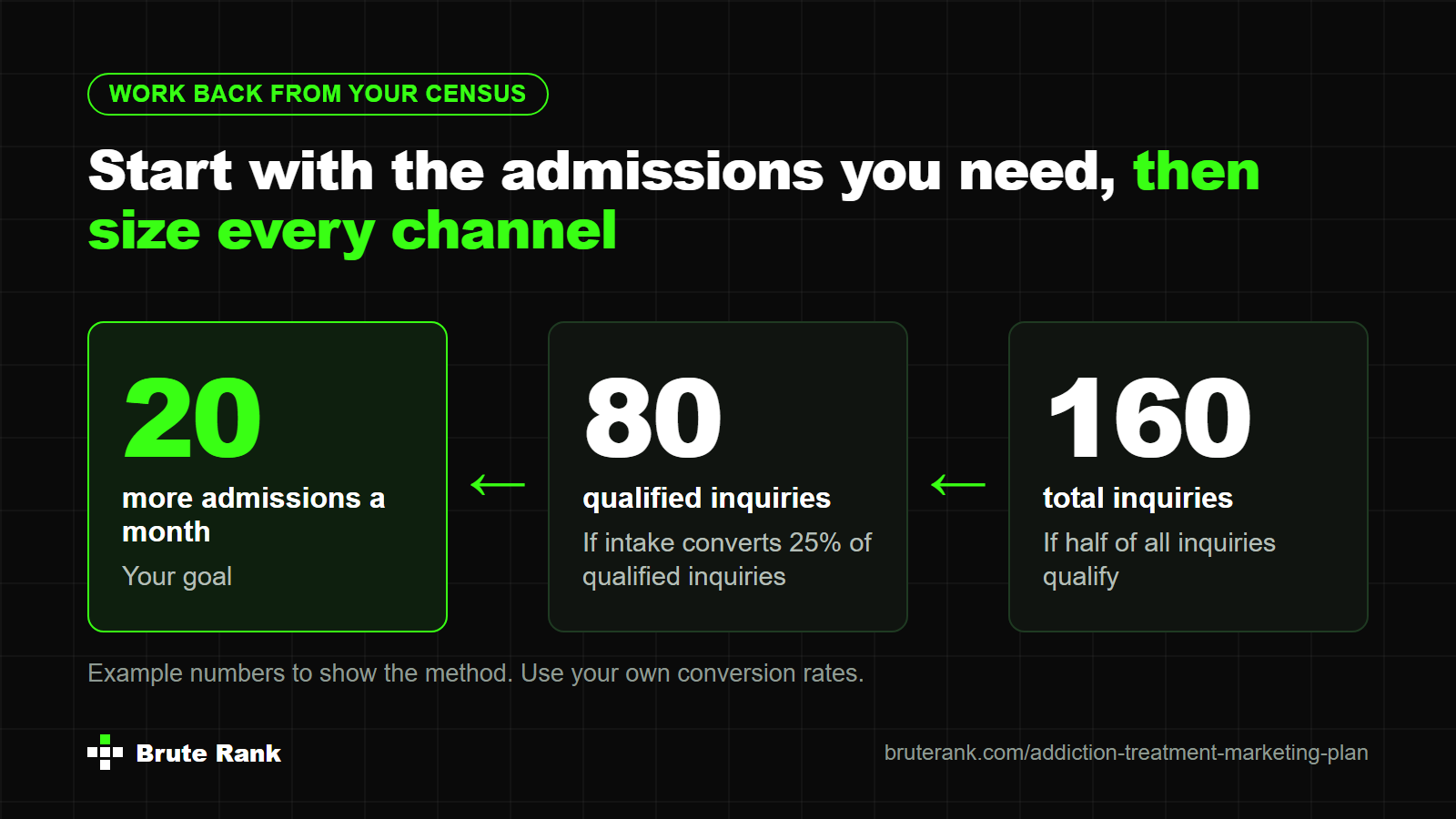
Work backward from the number that matters. If you need 20 more admissions a month, and intake converts 25% of qualified inquiries to admissions, you need 80 qualified inquiries. If half of all inquiries qualify, you need 160 inquiries. Now you know what each channel has to produce, and you can judge every channel by the same yardstick:
Cost per admission = monthly channel cost ÷ admissions from that channel
2. Know who you are marketing to
- The person who needs care: often searching late at night, ambivalent, worried about cost and privacy.
- Family members: frequently the ones who research, compare programs and make the first call.
- Referral partners: therapists, hospitals, EAPs, interventionists, courts, other programs and alumni.
- Payers: your insurance contracts shape which searches are worth winning.
3. Choose your channel mix
| Channel | Speed | Cost behavior | Best for |
|---|---|---|---|
| SEO | Slow to start | Mostly fixed, compounds | Lowest long-term cost per admission |
| Local SEO | Weeks to months | Mostly fixed | Detox, outpatient, sober living |
| Google Ads | Immediate once certified | Pay per click, stops when you stop | Filling beds now |
| Paid social | Immediate once certified | Pay per impression | Awareness, families, alumni events |
| Referral outreach | Months | Staff time | Steady, high-fit admissions |
| Email and alumni | Ongoing | Low | Readmissions, referrals, reviews |
The channels in your plan, one by one
SEO for addiction treatment centers
Search engine marketing in addiction treatment has two halves: paid ads and organic search. Organic is the one you own. It works when every level of care, substance, payer and location you serve has a page built for that search: “alcohol detox in Phoenix”, “IOP that takes Cigna”, “residential treatment for young adults”. Those pages keep producing calls without a bill per click, so cost per admission falls as they mature. Our addiction treatment SEO page explains the full approach.
Local SEO and your Google Business Profile
For “near me” searches, the map pack comes first. Each facility needs its own verified Business Profile with accurate categories, services, real photos and hours, plus consistent listings across the web. A verified profile is also your best defense against lead-generation sites that pose as local programs. See Map Pack Takeover for how we track map rankings street by street.
Drug rehab advertising: Google Ads and Microsoft Ads
Paid search is the fastest channel once you are certified, and the most expensive. In our analysis of rehab keyword costs, Ahrefs estimated US clicks at $14 for “rehab near me” and $19 for “detox near me”, with live auctions often higher. Make ads work by bidding on your own levels of care and payers, sending traffic to the matching page instead of the homepage, excluding locations and services you cannot serve, and tracking every call to admission.
Rehab center social media marketing
Social media rarely drives direct admissions for a rehab, but it builds the trust that makes people call. Use it for alumni community, staff introductions, family education and recovery events. Paid addiction treatment ads on Meta also require certification. Never reply to comments in a way that confirms someone was a patient.
Content marketing for drug rehab centers
Content answers the questions families ask before they are ready to call: How does insurance cover rehab? What happens in detox? Residential or IOP? How do I help someone who does not want help? Group content into clusters around each level of care, link it to your program pages, and have clinical staff review it. Done this way, content brings in families early and sends them to the page that converts.
AI search visibility
Families now ask ChatGPT, Gemini and Google’s AI Overviews which programs to consider. A Pew Research Center study found people clicked a traditional search result in 8% of visits when an AI summary appeared, compared with 15% without one. AI tools cite programs whose websites state clear facts: levels of care, conditions treated, insurance accepted, location, accreditation and staff. We cover this in detail in AI search visibility for treatment centers.
Reviews and reputation
In BrightLocal’s 2026 Local Consumer Review Survey, 97% of US consumers said they read reviews for local businesses, and 74% look for reviews written in the last three months. Ask alumni and families for honest reviews through a consistent process. Never offer incentives, and never reply in a way that confirms treatment. A California dental practice paid $23,000 to settle an HHS investigation after review replies disclosed patients’ information. The same risk applies to treatment centers.
Referral and business development marketing
Outreach to therapists, hospitals, EAPs and other programs still produces some of the best-fit admissions. Give referral partners something useful: clear admission criteria, fast responses and updates when their client arrives, with proper consent. Keep every arrangement clear of anything that looks like payment for referrals.
Email and alumni marketing
Alumni programs support recovery and also produce referrals and reviews. A simple monthly email with events, meetings and resources keeps your center in touch with the people most likely to recommend it.
A warning about rehab lead generation
Buying leads or calls is tempting when census drops. Be careful. Many lead sellers run the same call centers and directories that compete with you, some lead arrangements raise EKRA questions, and you never own the demand. Treat purchased leads as a short-term bridge at most, and put the long-term budget into channels that build your own visibility.
Intake: where the plan succeeds or fails
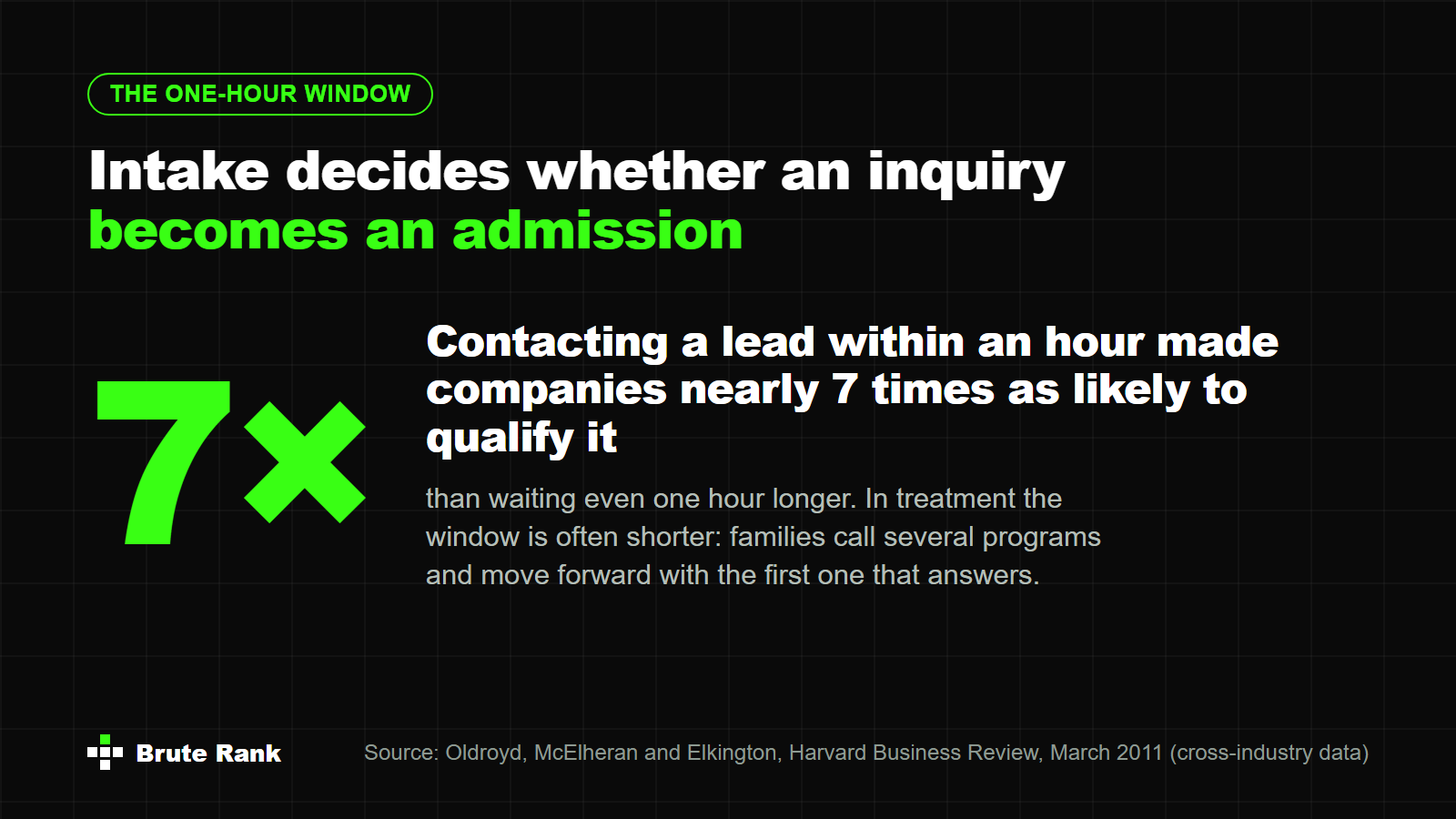
Marketing produces the inquiry. Intake produces the admission. A well-known Harvard Business Review study found that companies contacting leads within an hour were nearly seven times as likely to qualify them as companies that waited even one more hour. In treatment, the window is often shorter: families call several programs and usually move forward with the first one that answers and verifies insurance.
- Answer live, 24 hours a day, or use a trained answering service that can start a VOB.
- Respond to forms within minutes, not the next morning.
- Put the phone number and a short VOB form on every program and insurance page.
- Record and review calls (with appropriate notice) to see why inquiries do not convert.
Our speed to lead guide walks through a full intake audit.
How to measure your marketing plan
Traffic and rankings are leading indicators. Admissions and cost per admission are the result. Set up measurement before you scale any channel:
- Call tracking: separate numbers for each channel so every call is attributed, configured with privacy in mind.
- Form tracking: every VOB and contact form tied to its source page.
- Intake matching: each month, match inquiries to admissions in your EMR or CRM by channel.
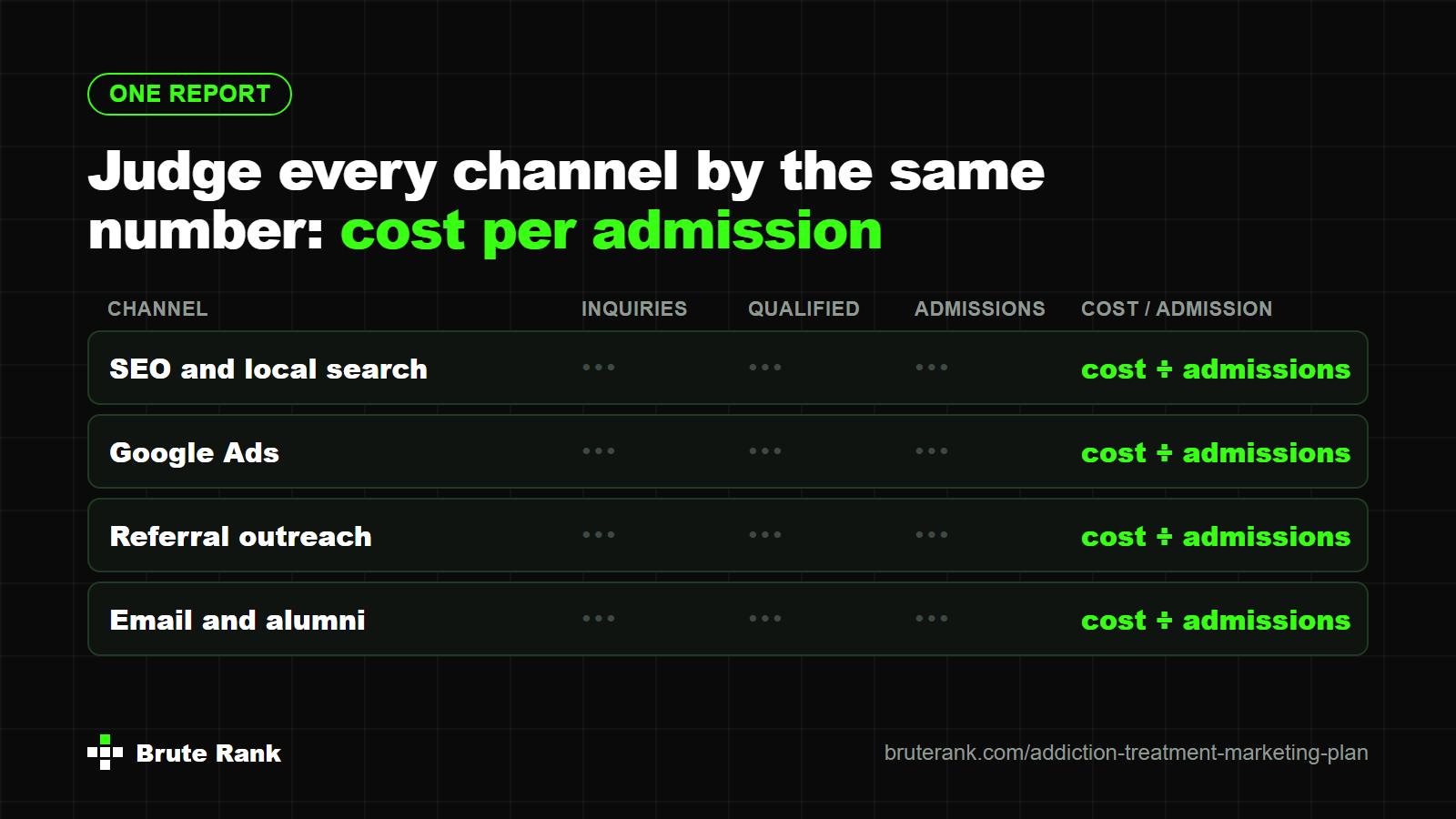
- One report: inquiries, qualified inquiries, admissions and cost per admission by channel, side by side.
See how we report this on our results and reporting page.
Marketing ideas by program type
Detox
Detox searches are urgent and often happen at night. Win the map pack, show availability and the phone number at the top of the page, explain medical supervision plainly, and make insurance verification fast.
Residential treatment
Families compare residential programs carefully and often across state lines. Show the daily schedule, clinical team, accommodations, accreditation and what happens after discharge. Real photos matter more here than anywhere else.
PHP and IOP
PHP and IOP searches are local and schedule-driven. Publish your hours, explain how programming fits around work or school, and build pages for each nearby city you realistically serve. Step-down from residential is a referral channel in itself.
Sober living
Sober living marketing is mostly local SEO, reviews and referral relationships with treatment programs. Explain house rules, costs, certification and what a typical week looks like.
Dual diagnosis and mental health programs
Many families search for help with a mental health concern first and substance use second. Build pages that connect the two, and see our mental health SEO page for programs focused on psychiatric care.
Adolescent and young adult programs
Parents research longer and need more reassurance. Explain education support, family involvement, safety and clinical credentials in detail, and give parents a way to ask questions before committing to a call.
Marketing plan mistakes to avoid
- Sending every ad click to the homepage instead of the matching program page.
- Bidding on competitor names with ads or call routing that could make people think they reached that competitor.
- Paying per admission, per patient or per referral.
- Fear-based copy, outcome guarantees or unsourced success rates.
- Fake reviews, incentivized reviews or replies that confirm someone was a patient.
- Ad pixels on intake forms that collect health information.
- Judging marketing by traffic instead of admissions.
Who should run the plan: your team or outside help?
Larger groups often keep business development and intake in-house and bring in specialists for SEO, paid search and analytics. Smaller centers usually get more from one specialist partner than from several generalists. Either way, a good outside partner should be able to answer these questions in writing:
- Do you report admissions and cost per admission, or only traffic and rankings?
- How do you handle LegitScript, EKRA and HIPAA in your work?
- Who owns the website, ad accounts, Business Profiles and tracking if we part ways?
- Do you sell leads to other centers, or work with our direct competitors?
- Will our clinical team approve every page before it goes live?
For more questions and red flags, see how to choose a rehab marketing agency.
Addiction treatment center marketing plan: frequently asked questions
What should an addiction treatment center marketing plan include?
Five parts: admissions targets by program and payer, the people you are marketing to (the person seeking care, their family and referral partners), a channel mix with a cost per admission goal for each channel, an intake process that answers fast and verifies insurance, and monthly reporting in admissions rather than clicks.
How do you start a drug rehab marketing plan?
Start with the basics that compound: a verified Google Business Profile for every facility, one page per level of care and payer, honest content for families, and call tracking tied to admissions. Add paid search once you are certified, and build referral relationships alongside it.
What is the best marketing strategy for a treatment center?
The best strategy is the one with the lowest cost per admission for your programs and market. For most centers that means SEO and local SEO as the foundation, paid search to fill short-term gaps, and a fast intake team that turns inquiries into admissions.
Can treatment centers advertise on Google and Facebook?
Yes, but only after certification. Google requires approval under its addiction services policy, and LegitScript certification is required for addiction treatment ads on Google, Meta, Microsoft Ads and Nextdoor.
How much should a rehab spend on marketing?
Work backward from your admissions goal and your cost per admission for each channel, rather than starting from a percentage. Track that cost monthly and move budget toward the channels that produce admissions most efficiently.
Is it legal to buy leads for a treatment center?
It depends on how the arrangement is structured. Paying for referrals of patients can violate EKRA and state patient brokering laws. Have healthcare counsel review any lead, referral or per-call arrangement before you sign.
How long does a rehab marketing plan take to show results?
Paid search can produce calls within days of approval, and Business Profile and technical fixes can show movement within weeks. New program and insurance pages usually take three to six months to rank well, and competitive metro markets take longer, so review the plan every quarter.
The bottom line
A marketing plan for a treatment center works when it is honest, specific and measured in admissions. Be easy to find for the exact care you provide, easy to trust when families arrive, and fast to answer when they call. If you want to see where your center stands today, request a free audit and we will show you where the calls are going and the fastest way to win them back.