In short: Good addiction treatment website design answers a family’s first questions within seconds: what you treat, which levels of care you offer, whether you take their insurance, where you are, what happens when they call, and how to reach a real person right now. Build it mobile first, with one page per program, honest photos and credentials, fast load times, accessible design and privacy-safe forms. On a rehab website, clarity and trust matter far more than decoration.
The person on your website is rarely browsing. It might be a father on his phone at midnight, reading about detox for his daughter. It might be a therapist checking whether your IOP takes a client’s insurance. It might be the future patient, deciding in the next few minutes whether to call anyone at all.
None of them care about your color palette. They want to know, quickly, whether you can help and how to start. This guide covers what addiction treatment website design needs to get right: the questions every page must answer, the pages every treatment center website needs, how to design for trust on a phone, and the technical basics that decide whether Google and AI tools can find you. It is written for owners and admissions leaders planning a new site or a redesign.
What families look for on a rehab website
A family arriving on a drug rehab website is trying to answer six questions, usually in this order:
- Do you treat what we are dealing with? Alcohol, opioids, stimulants, co-occurring mental health conditions.
- Which levels of care do you offer? Detox, residential, PHP, IOP, outpatient, sober living.
- Do you take our insurance? And if not, what are the options?
- Where are you? And can they get there, or is treatment available by telehealth?
- What happens when I call? Who answers, what they ask, how fast someone can be admitted.
- Can I talk to someone now? A phone number that works, day and night.
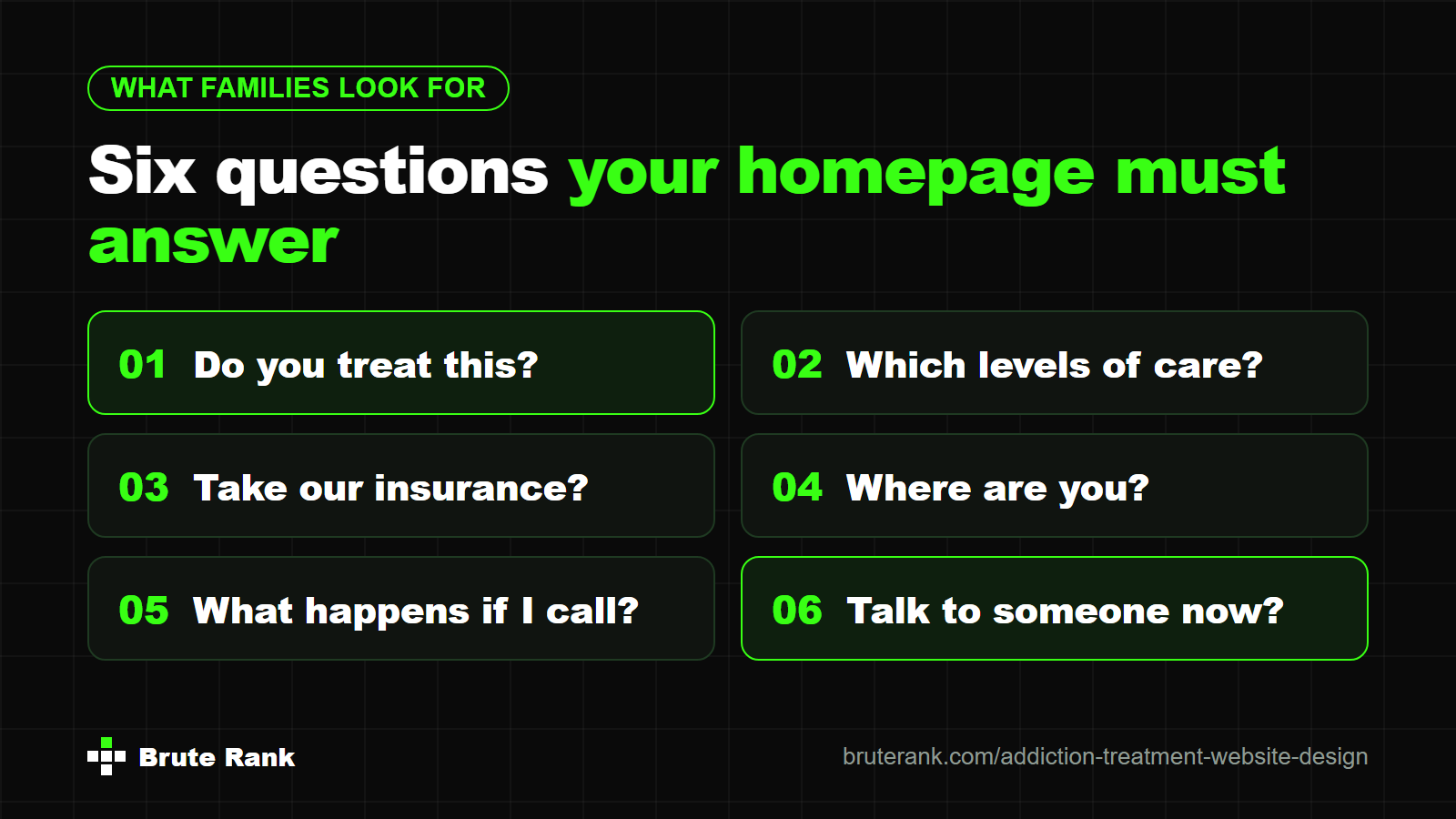
Good addiction treatment website design puts the answers to those six questions where people actually look: the top of the homepage, the top of every program page, and the header on every screen. If a visitor has to dig for any of them, many will go back to the search results and call the next center. Good rehab SEO earns the visit; the design is what turns it into a call.
The pages every addiction treatment website needs
The most common structural problem we see in addiction treatment website design is a single “Programs” page that lists every service in bullet points. It cannot rank for any of them, and it cannot answer the specific question a family came with. A treatment center website needs one focused page for each thing people search for:
| Page | What it answers | Example search it can win |
|---|---|---|
| Home | Who you help, where, and how to start | drug rehab in [city] |
| One page per level of care | What detox, residential, PHP, IOP or outpatient looks like with you | medical detox near me |
| Conditions and dual diagnosis | Substances and co-occurring conditions you treat | dual diagnosis treatment [city] |
| Insurance and cost | Plans you are in network with, how verification works | rehab that takes [insurer] |
| Admissions | What happens on the first call and the first day | how to get into rehab |
| Team and credentials | Clinical leadership, licenses, accreditations you hold | [your center name] reviews |
| Facility and location | Real photos, address, directions, what to bring | rehab near [town] |
| Family resources | How to help a loved one, family programming | how to help someone with addiction |
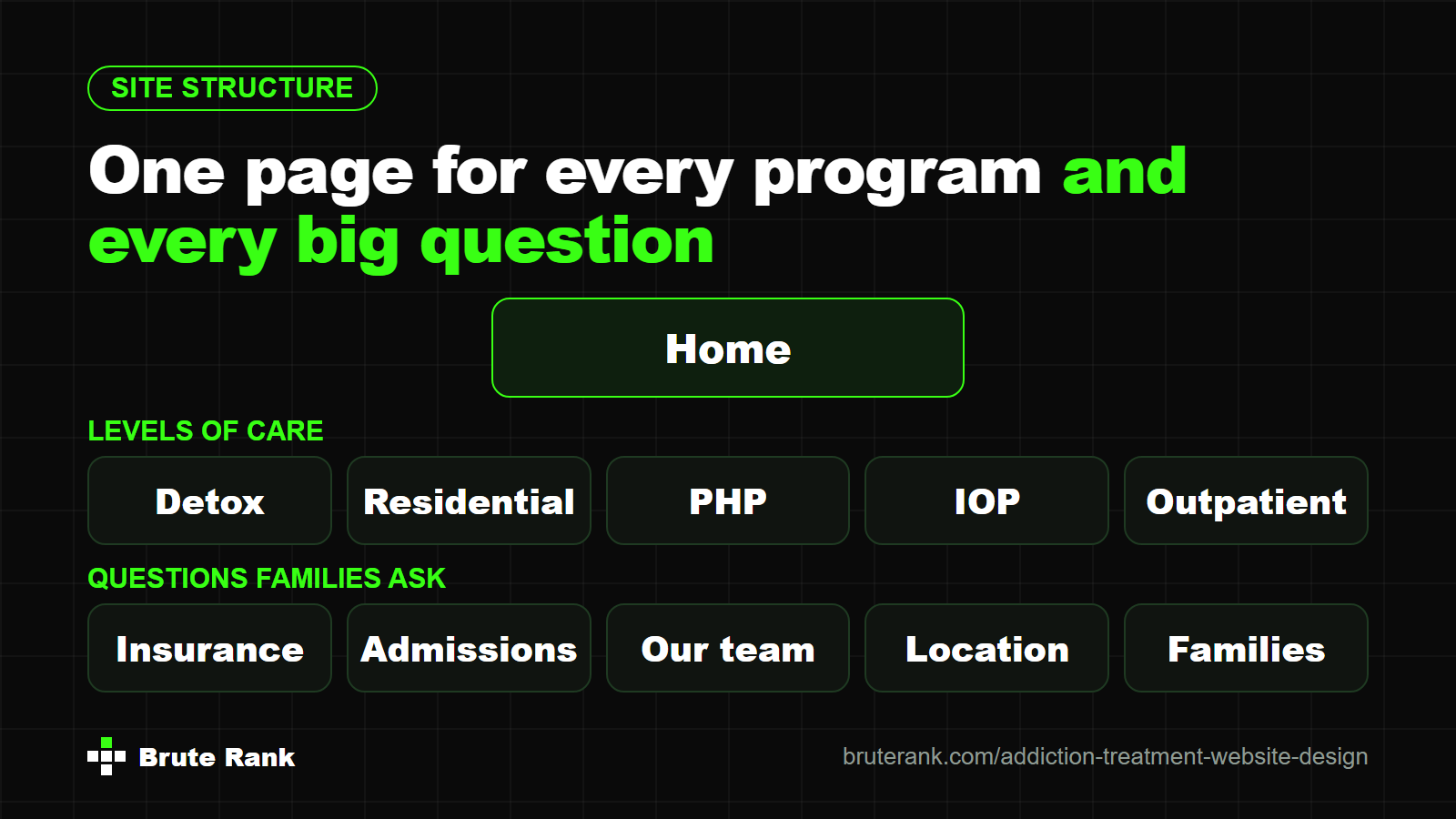
Each level-of-care page should explain who the program is for, what a day looks like, how long it usually lasts, what happens next, and which insurance covers it. That structure is the core of treatment program SEO, and it gives families the detail they need to say yes.
Your admissions page deserves special care. Walk people through the first call, the insurance check and the first day, and link to your verification form. We cover that process in our guide to insurance verification for rehab.
Addiction treatment website design for trust, not decoration
Choosing a treatment center is one of the most personal decisions a family will make, and Google holds health content to a higher standard too. Google says its systems give even more weight to content that shows strong experience, expertise, authoritativeness and trust (E-E-A-T) on topics that could significantly affect people’s health, which it calls “Your Money or Your Life” topics. Rehab website design should make trust visible:
- Real photos. Your actual rooms, common areas, entrance and team. Stock images of smiling strangers make families wonder what you are hiding.
- Named clinical leadership. Medical director, clinical director and therapists, with credentials and a short note on their approach.
- Licenses and accreditations you actually hold, stated accurately and linked where possible.
- Plain language. “Medical detox with 24-hour nursing” beats “a holistic continuum of transformative care”.
- Honest claims. No guaranteed outcomes and no invented success rates. Describe what you do, not what you promise. Federal law prohibits deceptive marketing of substance use disorder treatment, and the FTC has enforced it.
- Clear ownership. Families should be able to tell who runs the center and that they are talking to the center itself, not a call center.
Mobile-first addiction treatment website design
Google uses the mobile version of a site’s content for indexing and ranking, which it calls mobile-first indexing. In other words, the phone version of your site is the version Google judges. It is also the version most families see, often late at night and in private.
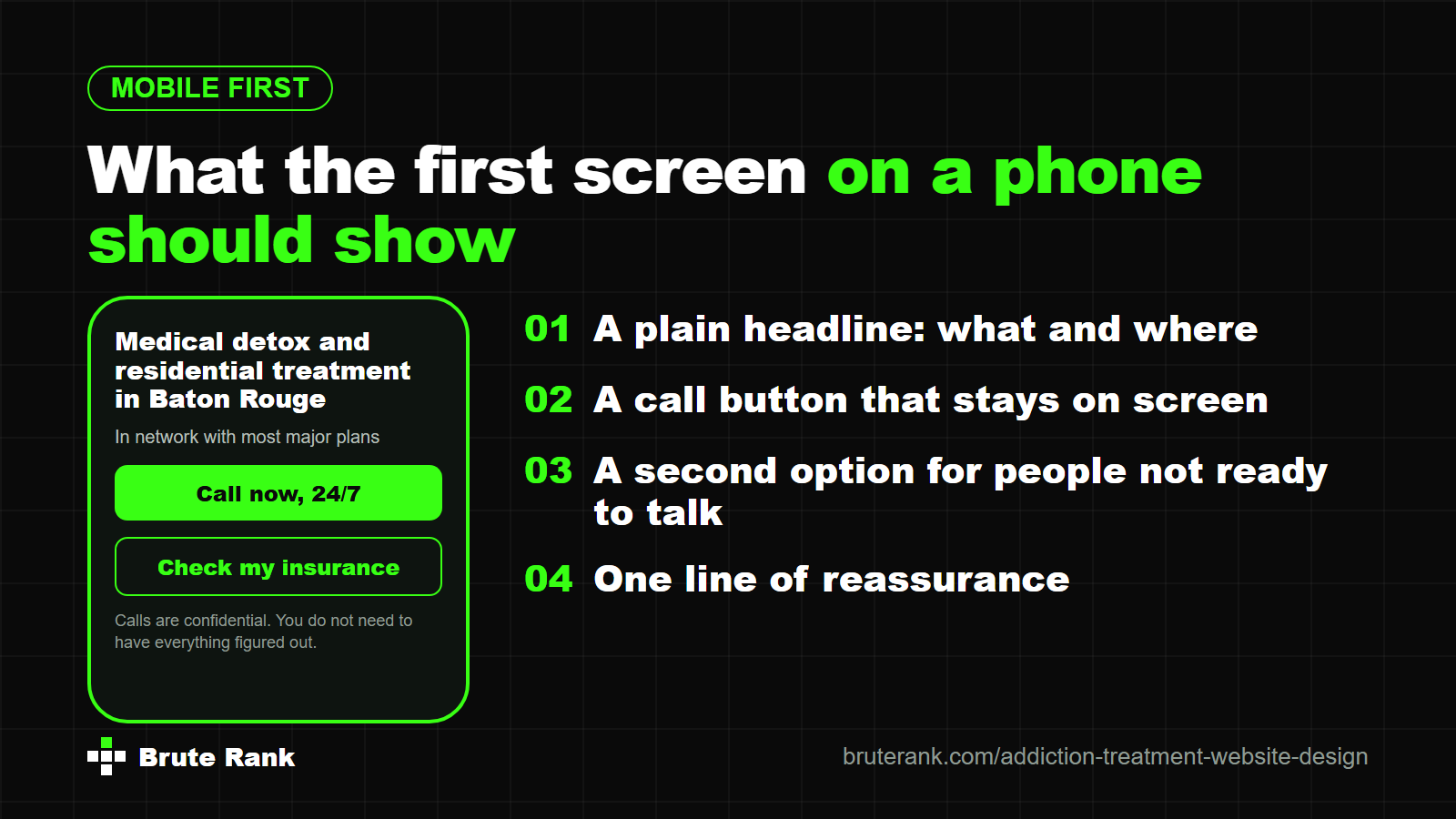
The first screen of every page on a phone should show:
- What the page is about, in one plain headline: “Medical detox and residential treatment in Baton Rouge”.
- A tappable call button that stays visible as people scroll, with a clear note if lines are answered 24/7.
- A second option for people who cannot talk yet: a short insurance check or a text or chat option.
- One line of reassurance, such as “Calls are confidential. You do not need to have everything figured out.”
Test it on a real phone, not a desktop browser made narrow. Tap the number, fill in the form with your thumb, and read the page in bright light. Anything awkward for you will stop someone in crisis.
Speed and Core Web Vitals
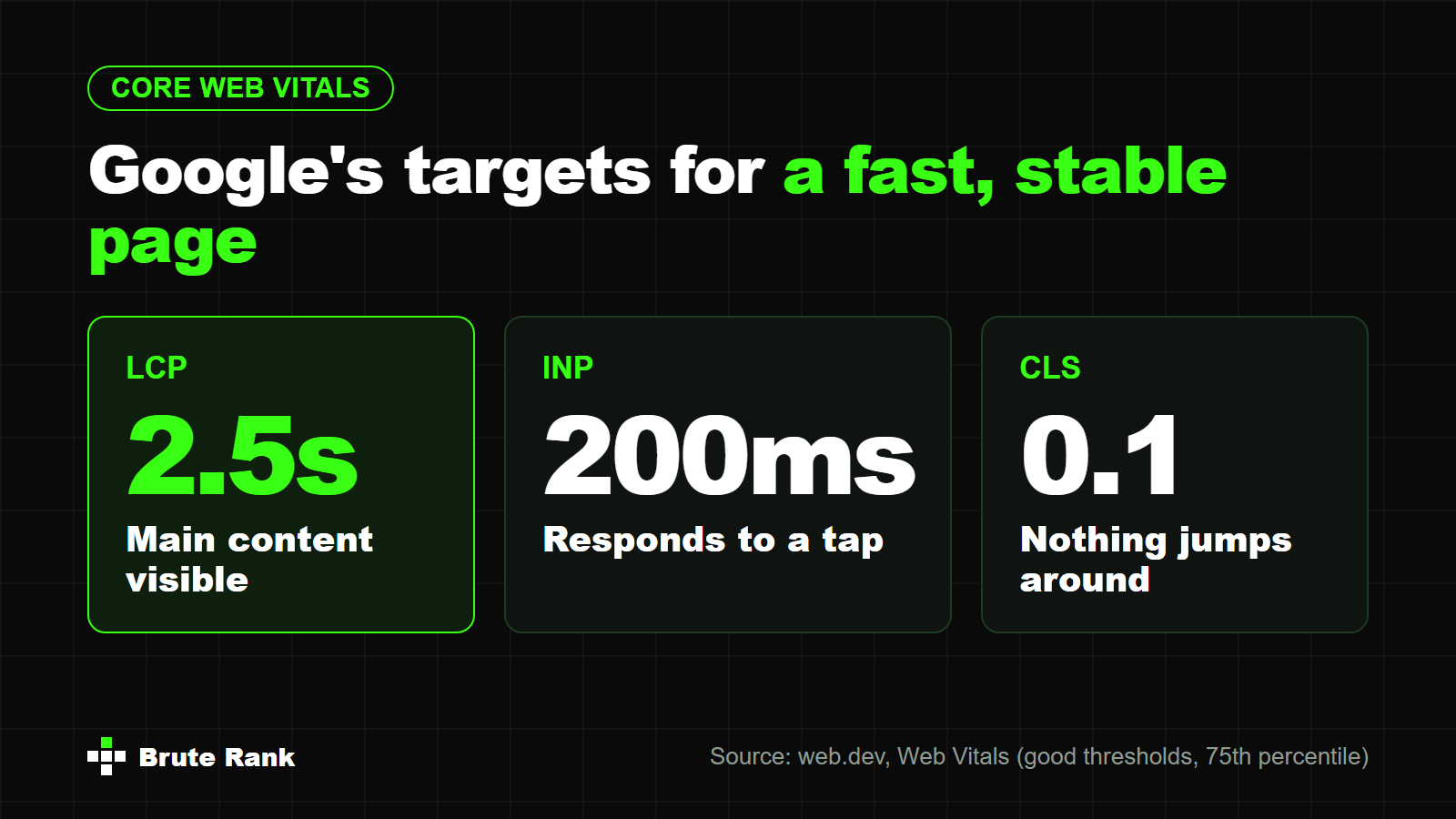
A slow treatment center website loses people before the first sentence loads. Google’s Core Web Vitals give clear targets for a good experience, measured at the 75th percentile of page loads on mobile and desktop:
- Largest Contentful Paint (LCP): the main content appears within 2.5 seconds.
- Interaction to Next Paint (INP): the page responds to a tap in 200 milliseconds or less.
- Cumulative Layout Shift (CLS): 0.1 or less, so buttons do not jump as the page loads.
The usual culprits on rehab websites are huge hero images and videos, chat widgets and tracking scripts loading before the content, and page builders stacking dozens of plugins. Compress images, load third-party scripts after the page, and remove anything nobody uses. This is the everyday work of technical SEO for treatment centers.
Accessibility is part of good design
The Department of Justice states that the Americans with Disabilities Act applies to businesses open to the public, and that its requirements cover what those businesses offer on the web. The DOJ points to the Web Content Accessibility Guidelines (WCAG) as helpful guidance. For a treatment center, accessible addiction treatment website design is also simply good care: some of the people you serve have low vision, tremors or cognitive fatigue, and many are reading under stress.
Start with the basics: readable text sizes and strong contrast, descriptive alt text on images, buttons and links large enough to tap, forms with clear labels and error messages, video captions, and a site that works with a keyboard and a screen reader.
Forms, tracking and privacy
Contact and insurance forms are where design meets compliance. Ask only for what admissions needs to start (name, phone, insurance carrier, member ID), say what happens next and how fast, and keep clinical questions for the call. Health information collected on your site, and the analytics and ad tools installed on those pages, need to be handled in line with HIPAA and your compliance team’s guidance, so involve them before launching any new form or tracking tag.
Structure your website for search and AI answers
Addiction treatment website design and SEO should be planned together, not one after the other. The pieces that matter most:
- One H1 per page that matches the search, such as “Residential Addiction Treatment in Columbus, Ohio”.
- Title tags that lead with the service and place, not your brand name alone.
- Headings that answer real questions (“How long is medical detox?”), with the answer in the first sentence.
- Internal links between related pages: your detox page links to residential, your insurance page links to verification.
- Structured data that states your name, address, phone, services and clinicians, so search engines and AI tools read the facts correctly.
- Content that builds authority on the topics you treat, which is what we mean by content marketing for treatment centers.
AI assistants such as ChatGPT, Gemini and Google’s AI Overviews now answer “which rehabs near me take Aetna?” directly. They can only recommend centers whose websites state clear, consistent facts about programs, insurance and location.
Common addiction treatment website design mistakes
- One “Programs” page trying to rank for every level of care.
- A homepage that opens with a mission statement instead of who you help, where, and how to start.
- A phone number that is not tappable, or is hidden in an image.
- Stock photos only, with no real faces, rooms or credentials.
- Insurance logos for plans you are not actually in network with.
- Long contact forms that ask for symptoms before anyone has spoken to the family.
- Slow pages weighed down by videos, sliders and unused plugins.
- A redesign that changes every URL without redirects, wiping out years of rankings.
Planning a redesign without losing rankings
A new addiction treatment website design should not cost you the search traffic you already have. Before launch, list every current URL and the searches it ranks for, keep the URLs that work, set up permanent (301) redirects for any that change, carry over page titles and content that already rank, and check Google Search Console for errors in the weeks after launch. Then measure what matters: calls, verification forms and admissions by page, not just traffic.
Key takeaways
- Addiction treatment website design should answer six questions fast: what you treat, levels of care, insurance, location, what happens on the call, and how to reach someone now.
- Build one page per level of care, plus insurance, admissions, team, facility and family pages.
- Make trust visible with real photos, named clinicians, accurate credentials and honest claims.
- Design for the phone first, with a sticky call button, and meet Google’s Core Web Vitals targets.
- Plan accessibility, privacy-safe forms and SEO structure into the design, and protect your rankings with redirects during a redesign.
Addiction treatment website design: frequently asked questions
What should an addiction treatment website include?
At minimum: a homepage that says who you help and where, one page per level of care, a conditions and dual diagnosis page, an insurance and cost page, an admissions page, team and credentials, real facility photos and location details, family resources, and a contact page with a tappable phone number and a short insurance check form.
What makes a good rehab website design?
Clarity and trust. A family should be able to tell within seconds what you treat, which levels of care you offer, whether you take their insurance and how to reach a real person. Real photos, named clinicians, plain language and a fast, mobile-friendly layout matter more than visual style.
Why does mobile design matter so much for treatment centers?
Google uses the mobile version of a site for indexing and ranking, and many families search for treatment on their phones, often late at night. If your phone layout hides the call button or loads slowly, you lose both rankings and calls.
Does a rehab website need to be HIPAA compliant?
If a treatment center is a HIPAA covered entity, health information collected through its website, and the tools that receive it, need to be handled under HIPAA. Keep forms limited to what admissions needs, and have your compliance team review any form, chat or tracking tool before it goes live.
How many pages should a treatment center website have?
Enough to give every program and every common question its own page. For most centers that means a page for each level of care, each major condition or specialty, insurance, admissions, team, facility, location and family resources, plus helpful articles. Quality and focus matter more than the total count.
Should a rehab website be accessible under the ADA?
The Department of Justice says the ADA applies to businesses open to the public, including what they offer on the web, and points to WCAG as helpful guidance. Accessible design also helps every visitor, especially people reading under stress or on small screens.
Will a website redesign hurt my search rankings?
It can if URLs change without redirects, ranking content is removed, or pages become slower. Map every existing URL first, keep or redirect each one with a permanent 301 redirect, carry over content that ranks, and monitor Google Search Console after launch.
Brute Rank works only with behavioral health providers. We help treatment centers plan websites that rank and convert: one page per program, fast mobile pages, clear insurance information and the tracking to see which pages produce admissions. If you are planning a new site or a redesign, request a free SEO audit and we will show you what to keep, fix and build.
Sources
- Google Search Central: Mobile-first indexing best practices
- web.dev: Web Vitals
- Google Search Central: Creating helpful, reliable, people-first content
- U.S. Department of Justice: Guidance on Web Accessibility and the ADA (2022)
- FTC: First case under the Opioid Addiction Recovery Fraud Prevention Act (2022)