In short: Insurance verification for rehab, also called a verification of benefits (VOB), is how a treatment center confirms what a person’s health plan will pay before admission: whether the plan is active, network status, deductible, out-of-pocket costs, which levels of care are covered and whether prior authorization is needed. A good VOB ends with a clear, written answer for the family within hours, not days. Slow or confusing verification is one of the most common places the rehab admissions process loses people.
It is 9:40 on a Sunday night. A mother fills in the “verify your insurance” form on a drug rehab’s website for her son, who has finally agreed to get help. The page says someone will be in touch. Monday afternoon, nobody has called. By Tuesday she has spoken to two other programs, and one of them already has a bed ready.
Nothing about that center’s care was wrong. Its insurance verification was just slower than the program down the road. This guide explains how insurance verification for rehab works, what a VOB should answer, how families search for coverage, and how admissions teams can turn verification into admissions instead of lost calls.
What is insurance verification for rehab?
Insurance verification for rehab is the check a treatment facility runs with a person’s health plan to confirm what addiction treatment it will cover and what the person will owe. In the industry it is usually called a VOB, short for verification of benefits.
The admissions team, a utilization review or billing specialist, or an outside verification service collects the plan details (carrier, member ID, date of birth, policyholder) and contacts the insurer by phone or through the payer’s online portal. The result is a summary of benefits for each level of care the person might need, from detox to residential, PHP, IOP and outpatient. If those calls start from Google, SEO for addiction treatment centers decides how many families reach that verification step at all.
A VOB is a starting point, not a promise. Insurers usually state that a benefits quote is not a guarantee of payment, and coverage for a stay still depends on medical necessity and any reviews the plan requires.
What does a VOB check?
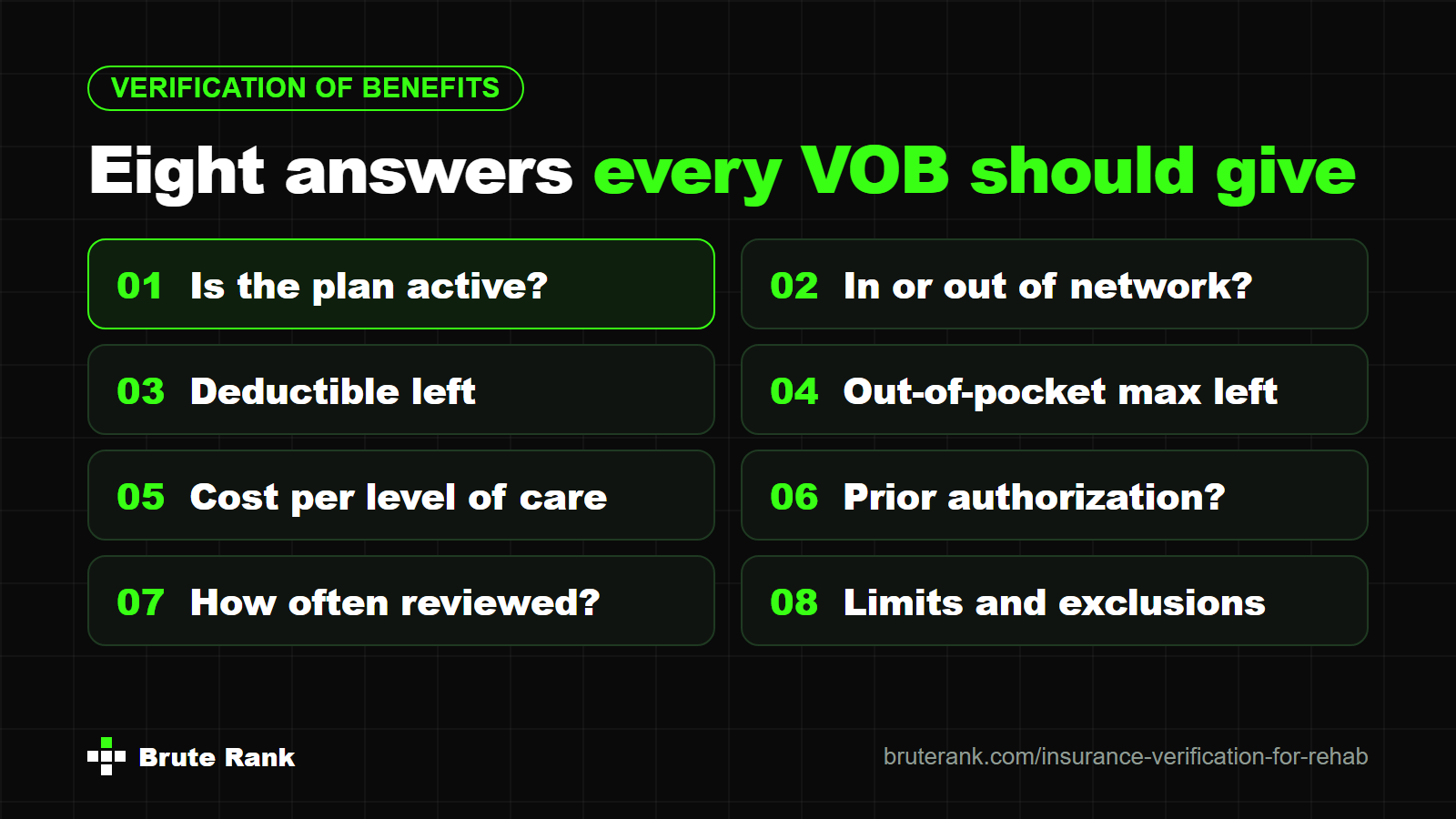
A complete verification of benefits answers the questions a family will ask before they say yes, and the questions your billing team will need answered before admission:
- Is the plan active, and on what dates?
- Is your center in network or out of network? If out of network, does the plan have out-of-network benefits at all?
- Deductible: how much is it, and how much has already been met this year?
- Out-of-pocket maximum: the most the person pays in a year, and how much is already met.
- Copays or coinsurance for each level of care: detox, residential, PHP, IOP, outpatient and medication-assisted treatment.
- Prior authorization: does the plan require approval before admission, and who requests it?
- Reviews: how often will the plan review medical necessity during a stay?
- Limits and exclusions: any caps or services the plan does not cover.
If the VOB cannot answer one of these, say so to the family plainly and tell them when you will know.
Does insurance cover rehab?
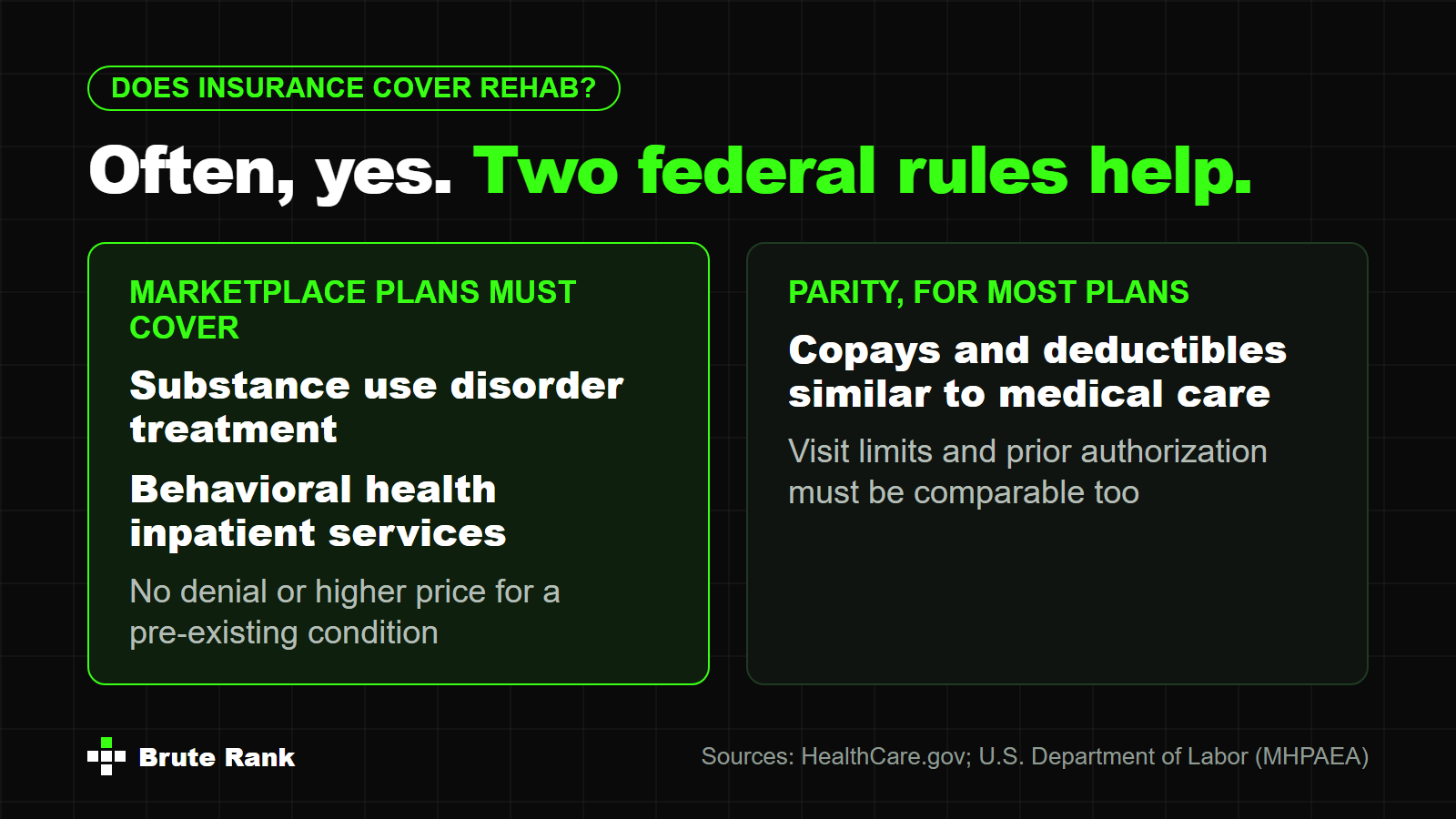
Often, yes, but the details depend on the plan. HealthCare.gov states that all Marketplace plans cover mental health and substance use disorder services as essential health benefits, including substance use disorder treatment and mental and behavioral health inpatient services. Marketplace plans also cannot deny coverage or charge more because of a pre-existing condition, including a substance use disorder.
Federal parity law adds another protection for most plans. The Department of Labor explains that under the Mental Health Parity and Addiction Equity Act, copays and deductibles for mental health and substance use benefits need to be similar to those for medical care, and that visit limits, prior authorization and medical necessity requirements need to be comparable too.
Coverage still varies a lot between plans, states and programs. Medicaid, employer plans and Marketplace plans each have their own networks and rules, which is exactly why every admission needs its own verification.
How families search for rehab insurance coverage
Insurance is one of the first things families look up when they start searching for treatment. These are monthly US searches from Ahrefs Keywords Explorer, pulled November 9, 2026:
| Search | Monthly US searches |
|---|---|
| does insurance cover rehab | 800 |
| rehabs that accept medicaid | 600 |
| is rehab covered by insurance | 350 |
| does medicaid cover rehab | 350 |
| insurance verification for rehab | 300 |
| does blue cross blue shield cover rehab | 200 |
| does insurance cover inpatient rehab | 200 |
| rehab admissions process | 150 |
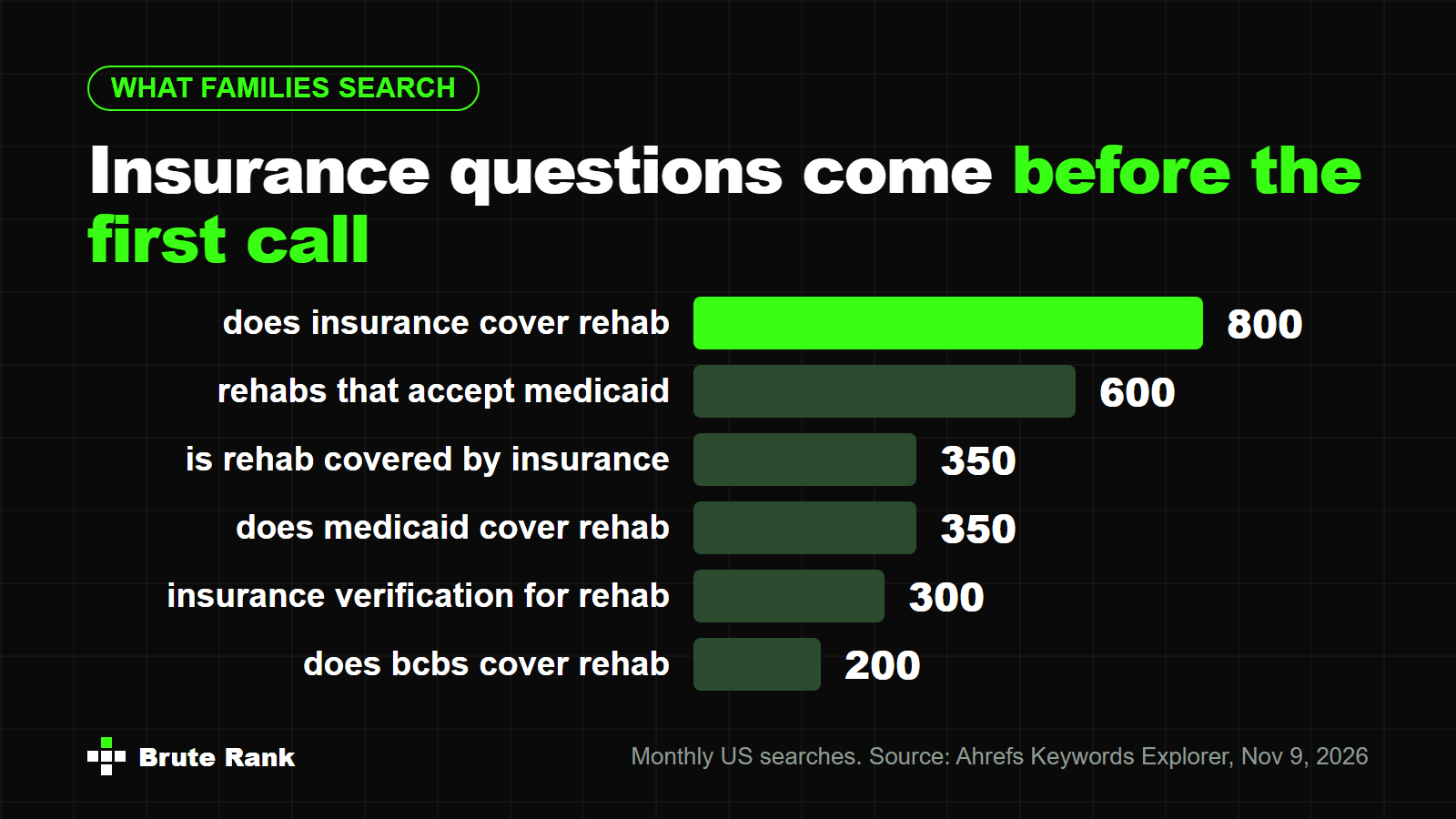
Two lessons for an addiction treatment center. First, families want a direct answer to “will my insurance pay?”, so your website should explain how verification works and how fast you respond. Second, plan-specific searches like “does blue cross blue shield cover rehab” are opportunities: an accurate page for each plan you are in network with can answer that question and lead straight to your verification form. Only list plans you actually accept. Building those pages is part of treatment program SEO.
The rehab admissions process, step by step
Insurance verification sits in the middle of the rehab admissions process, which is why delays there are so costly. A typical path looks like this:
- First contact: a call, chat, or insurance verification form.
- Pre-screen: a short conversation about substances, history, safety and the level of care that may fit.
- Verification of benefits: the insurance check, ideally running while the pre-screen continues.
- Clinical assessment: a fuller assessment to confirm level of care and medical needs, such as whether medical detox is required.
- Financial conversation: a plain explanation of what insurance covers and what the person may owe.
- Prior authorization, if required: the request to the plan before admission.
- Admission: travel, arrival time and what to bring.
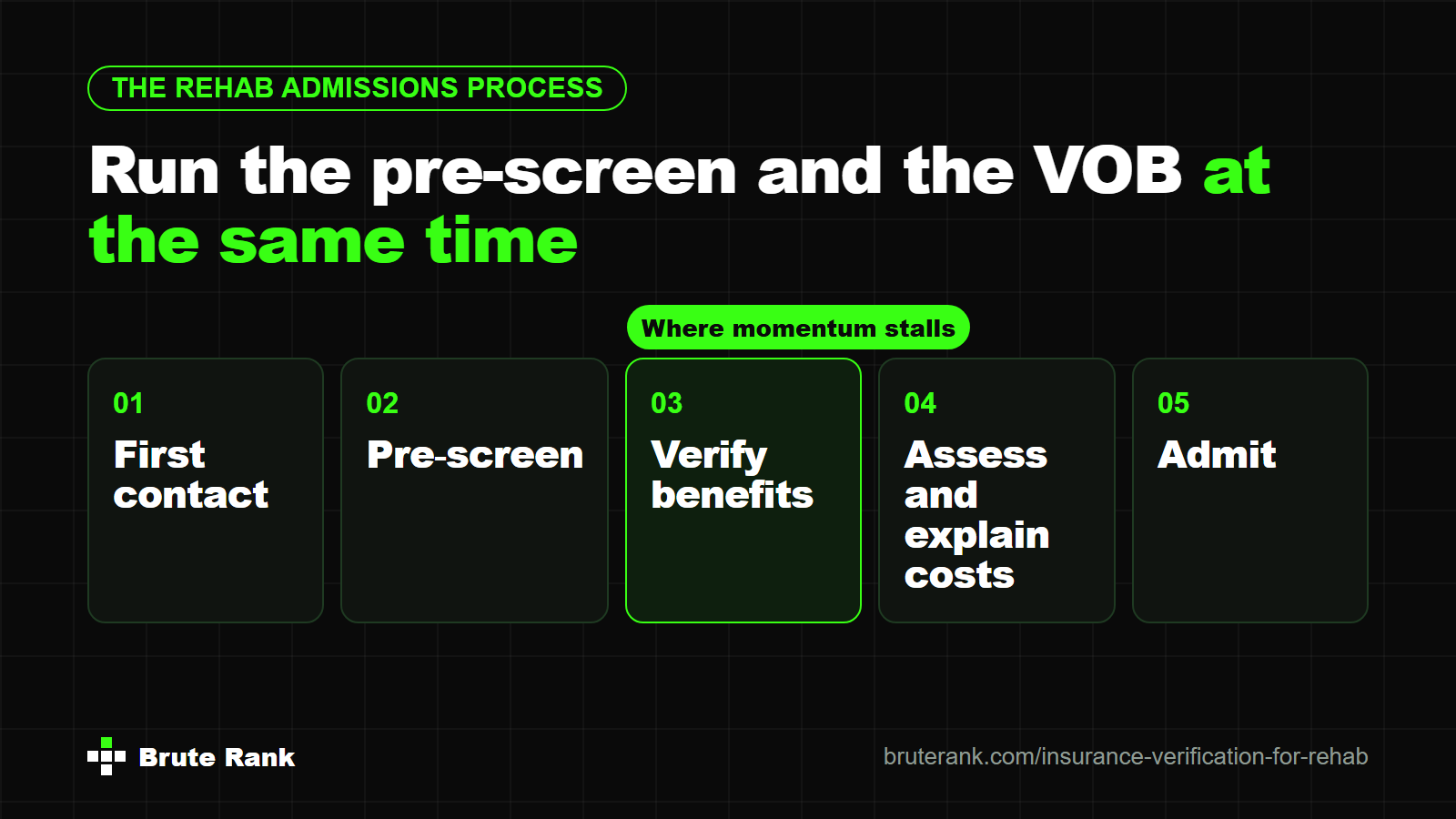
Every hand-off between those steps is a chance for a family to stop and call someone else. The best recovery centers run steps 2 and 3 at the same time, so the person never waits in silence while the insurance check runs.
How long should insurance verification for rehab take?
As fast as you can give an accurate answer, because families rarely wait. Most people contact more than one program, and the research on response time shows how quickly the odds of reaching someone fall, which we cover in our guide to speed to lead for treatment centers.
There is no industry standard for VOB turnaround, so set your own target and measure it. Track the time from form submission or first call to a clear answer for the family, report the median every week, and break it out by time of day and day of week. If verifications submitted on Friday evening are answered on Monday, that is where your admissions are going.
How to make insurance verification for rehab faster
Small changes to the rehab admissions process cut hours off verification:
- Keep the form short. Ask for name, phone, insurance carrier, member ID and date of birth. Everything else can wait for the call. Make sure any form that collects insurance details is handled in line with your privacy and compliance requirements.
- Call the family first. Start the pre-screen right away and run the VOB in parallel, instead of waiting for benefits before you talk.
- Cover nights and weekends. Someone needs to be able to run or at least start a verification outside office hours, or to tell the family exactly when they will hear back.
- Use payer portals where you can. Many insurers let providers check eligibility and benefits online, which is often faster than waiting on hold.
- Use one VOB template. Every verification should record the same fields, so nothing is missed and anyone on the team can pick it up.
- Flag prior authorization early. If the plan requires it, start that request as soon as clinical information is ready.
- Alert the on-duty staff instantly. A new verification form should send a text or app notification, not sit in an inbox.
- Follow up even when the answer is no. If you are out of network or the plan will not cover the level of care, help the family find an option that fits. They will remember who helped.
How to explain benefits to families
Most families have never heard the words deductible, coinsurance and out-of-pocket maximum in the same sentence, and they are hearing them at one of the hardest moments of their lives. Keep the conversation simple:
- Lead with the answer: “Your plan covers residential treatment with us. Based on what the insurer told us today, your share is likely to be about this much.”
- Explain one term at a time, in plain words: “Your deductible is what you pay before the plan starts paying.”
- Give it in writing, with the date and the insurer reference number for the call.
- Be honest about uncertainty: say that the insurer’s quote is not a guarantee and that the plan may review the stay.
- Never pressure. A clear, calm answer earns more trust than urgency.
Common verification mistakes that cost admissions
- Letting a verification form wait overnight or over the weekend without a reply.
- Asking for a long list of details on the website form before anyone has spoken to the family.
- Verifying only one level of care, then having to start again when the assessment changes the plan.
- Quoting costs as certain when the insurer has said they are not guaranteed.
- Not recording where the inquiry came from, so you cannot tell which channels produce verified, admitted patients. Our guide to rehab lead generation covers how to compare sources.
- Dropping out-of-network families without helping them find another option.
Key takeaways
- Insurance verification for rehab, or VOB, confirms coverage, network status, costs, covered levels of care and prior authorization before admission.
- Marketplace plans must cover substance use disorder treatment as an essential health benefit, and parity rules apply to most plans, but every plan still needs its own check.
- Families search for insurance answers early, so explain verification on your site and build pages for the plans you accept.
- Run the pre-screen and the VOB at the same time, and measure verification turnaround every week.
- Explain benefits in plain language, in writing, and never promise what the insurer has not guaranteed.
Insurance verification for rehab: frequently asked questions
What is insurance verification for rehab?
It is the check a treatment center runs with your health plan before admission, often called a verification of benefits (VOB). It confirms whether the plan is active, whether the center is in network, your deductible and out-of-pocket costs, which levels of care are covered and whether prior authorization is needed.
What information is needed to verify insurance for rehab?
Usually the insurance company name, member ID, the policyholder’s name and date of birth, and the patient’s name and date of birth. A photo of the front and back of the insurance card helps. The treatment center contacts the insurer with these details.
How long does insurance verification for rehab take?
Many centers can give a first answer within hours during business hours, but it depends on the insurer and the center’s staffing. Plans that require prior authorization can take longer. Ask the center when you will hear back, and expect a call the same day if you reach out during the week.
Does insurance cover rehab?
Often it does. All Marketplace plans must cover substance use disorder treatment as an essential health benefit, and parity rules mean most plans cannot make mental health and substance use benefits more restrictive than medical benefits. What you pay depends on your plan, your deductible and whether the center is in network.
What is the difference between in-network and out-of-network rehab?
An in-network rehab has a contract with your insurance company, so you usually pay less. An out-of-network rehab has no contract, so costs are often higher, and some plans have no out-of-network benefits at all. A verification of benefits tells you which applies.
What happens if insurance does not cover rehab?
Ask the center about other levels of care your plan does cover, payment options, or programs that accept your insurance. A good admissions team will help you find another option instead of ending the call. Public programs and state resources may also help.
Is a verification of benefits a guarantee of payment?
No. A VOB is the insurer’s description of your benefits on the day of the call. Insurers usually state that it is not a guarantee of payment, and coverage can still depend on medical necessity and plan reviews during treatment.
Brute Rank works only with behavioral health providers. We help treatment centers turn searches like “does my insurance cover rehab” into verified, admitted patients, with insurance and program pages that rank and verification forms that reach your team fast. Learn more about our SEO for treatment centers, or request a free SEO audit.