In short: SEO for therapists means making your practice easy to find in Google’s map results, regular search results and AI answers when someone looks for help. Start with a complete Google Business Profile, one page per specialty written in the words clients search, matching directory listings and an ethical approach to reviews. Group practices gain the most, because every clinician and specialty can rank on its own.
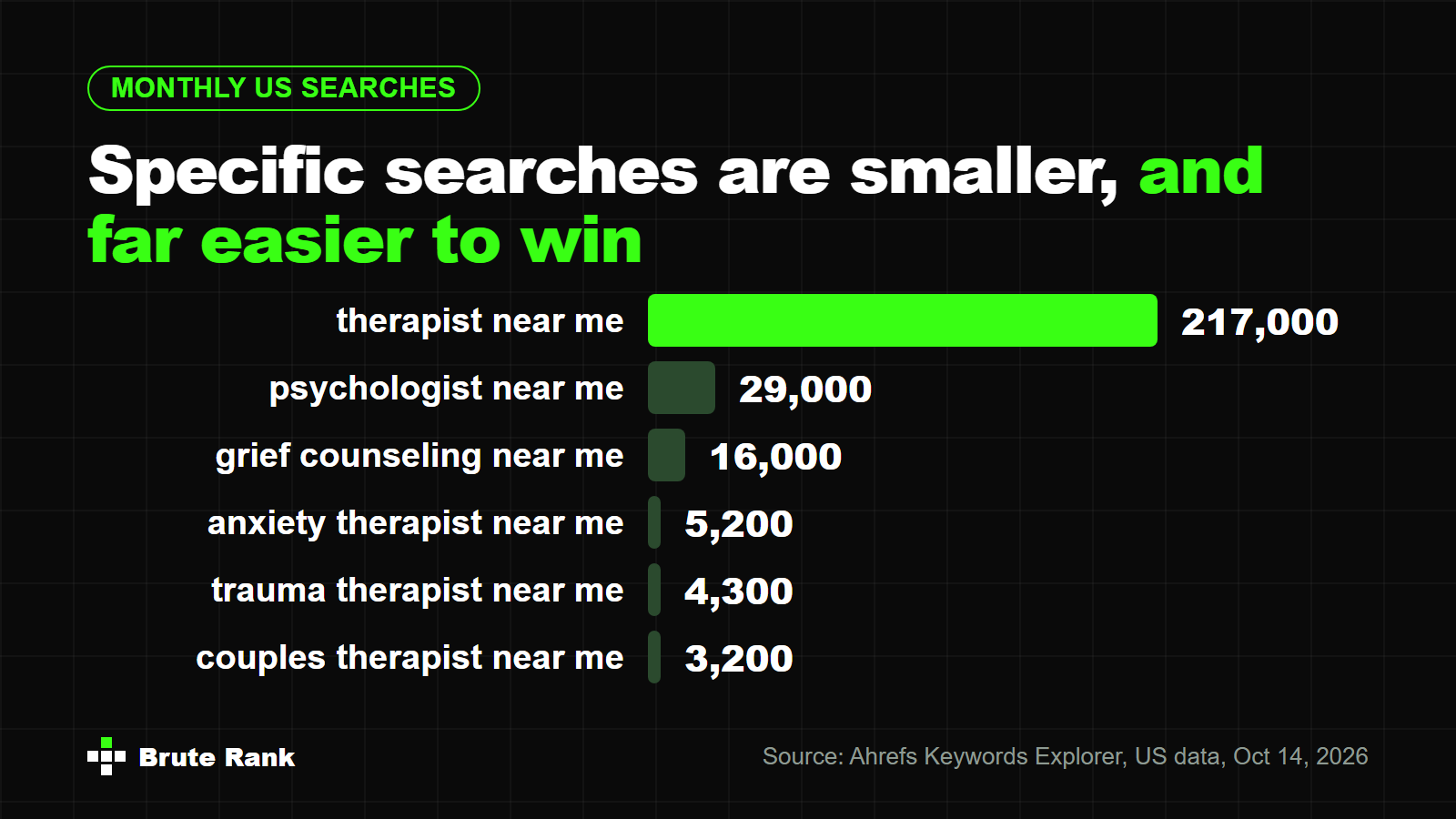
Every month, Americans search “therapist near me” about 217,000 times. Add “psychologist near me”, “counselor near me”, “anxiety therapist near me” and hundreds of variations, and you get a steady stream of people looking for exactly what you offer. Most of them will choose from the first handful of names they see.
SEO for therapists is how your practice becomes one of those names. This guide covers the whole process: the keywords clients actually use, local SEO and your Google Business Profile, how to structure a therapist website, the content that builds trust, and the ethical and HIPAA lines that make mental health different from every other kind of local business. It is written for solo clinicians, group practices and clinics alike, and every statistic is linked to its source.
What is SEO for therapists?
SEO for therapists (search engine optimization) is the work of making a therapy practice easy to find, understand and trust when someone searches for help online. In practice, that means showing up in three places:
- The map pack: the three practices Google shows on a map for searches like “couples counseling near me”. This is driven by your Google Business Profile, your location and your reviews.
- Organic results: the regular listings under the map. These are driven by your website: its pages, its content and the links pointing to it.
- AI answers: Google AI Overviews, ChatGPT, Gemini and Perplexity increasingly answer “who treats OCD in Denver?” directly. They can only name practices whose websites state clear, consistent facts.
Therapist SEO is not a trick or a one-time setup. It is a set of signals that tell Google three things: what you treat, where you treat it, and why a person should trust you with something this personal.
Is SEO for therapists worth it?
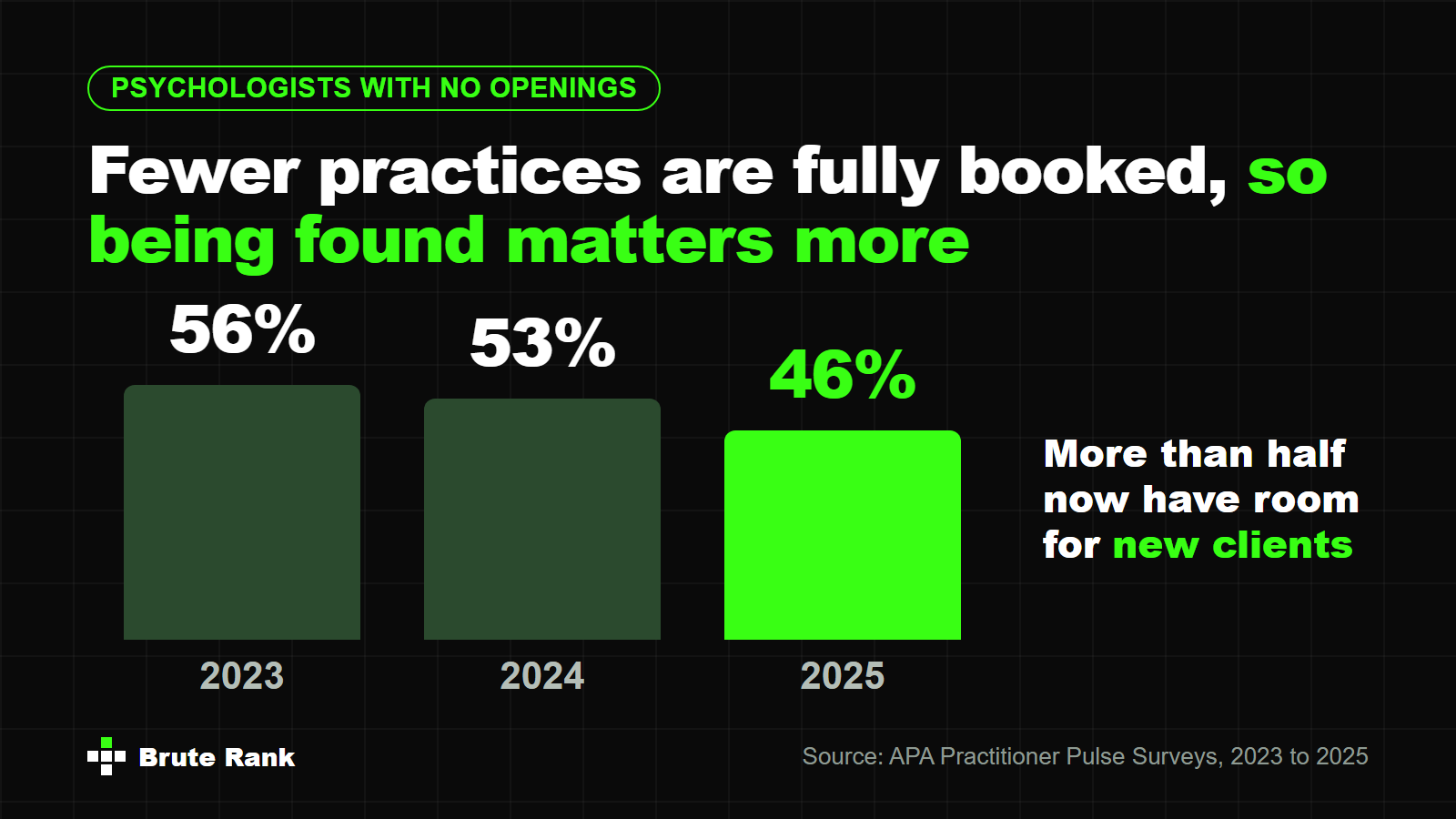
It depends on your caseload. According to the American Psychological Association’s 2025 Practitioner Pulse Survey, 46% of psychologists reported having no openings for new patients, down from 53% in 2024 and 56% in 2023. That trend matters. A few years ago, many clinicians could fill a schedule from referrals alone. Today more than half of surveyed psychologists have room for new clients, and those openings are filled by whoever is easiest to find.
SEO for therapists is worth it when at least one of these is true:
- You have openings, or you are about to hire another clinician.
- You want more of a specific client: trauma, couples, teens, a certain payer or private pay.
- You depend on one directory or one referral source and want a channel you own.
- You run a group practice where every empty hour costs you a clinician’s time.
If your caseload is full and your waitlist is long, SEO can wait. Your time is better spent on a clear website that answers the questions people ask before they call, so you can grow the moment you need to.
Step 1: Find the keywords your clients actually use
Therapist SEO starts with the words clients actually type, which are rarely the clinical terms on a practice website. Most therapists describe their work in clinical language. Most clients search in plain language. The gap between “evidence-based treatment for generalized anxiety disorder” and “why can’t I stop worrying” is where many practice websites lose. The best SEO keywords for therapists come from five groups:
- Provider + location: therapist near me, counselor in Austin, psychologist Brooklyn.
- Concern + location: anxiety therapist near me, grief counseling near me, trauma therapist Chicago.
- Modality: EMDR therapy, DBT, CBT for insomnia, play therapy, Gottman couples therapy.
- Population: therapist for teens, therapy for new moms, LGBTQ+ affirming therapist, therapist for first responders.
- Payer and format: therapist that takes Aetna, sliding scale therapy, online therapy in Ohio.
| Search | Monthly US searches |
|---|---|
| therapist near me | 217,000 |
| therapists near me | 42,000 |
| psychologist near me | 29,000 |
| grief counseling near me | 16,000 |
| counselor near me | 5,900 |
| anxiety therapist near me | 5,200 |
| trauma therapist near me | 4,300 |
| couples therapist near me | 3,200 |
Notice how much smaller the specific searches are than “therapist near me”. That is good news. Broad terms are dominated by large directories. Specific terms like “trauma therapist near me” or “EMDR therapy in Tampa” are far easier to win, and the people searching them already know what they need.
How to build your own keyword list
- Write down the five concerns you most want to treat, and the modalities you use for each.
- Type each one into Google with your city and note the autocomplete suggestions and the “People also ask” questions.
- Ask your intake person, or check your intake forms, for the exact words new clients use on first contact.
- Once your site is live, connect Google Search Console. After a few weeks it shows the real searches that already trigger your pages.
One rule: only target what you actually treat. A page for every condition in the DSM brings inquiries you have to turn away, and it weakens the trust signals Google looks for on health topics.
Step 2: Local SEO for therapists
For most practices, local SEO is the fastest win in SEO for therapists, counselors and psychologists. When someone searches “counselor near me”, Google shows a map with three practices before any website. Getting into those three spots comes down to three factors Google names in its own help center: relevance, distance and prominence. You cannot move your office, but you can control relevance and prominence.
Set up your Google Business Profile properly
- Categories: choose the most accurate primary category, such as Psychotherapist, Psychologist, Counselor or Marriage or relationship counselor, then add secondary categories only if they are true.
- Services: list each concern and modality you offer, using the same names as the pages on your website.
- Description: say who you help, how and where, in plain language. No keyword stuffing.
- Photos: your real office, entrance and team. Clients want to know what walking in will feel like.
- Hours, phone and booking link: keep them accurate. A wrong number costs you the client and confuses Google.
Practitioner profiles for group practices
Google’s guidelines for representing your business allow public-facing professionals, such as doctors and therapists, to have their own individual practitioner profile, separate from the practice’s profile. For group practices, that can mean several clinicians appearing in local results instead of one listing. Follow the naming rules exactly: the practitioner’s name and credential, not the practice name. A practice that only sees clients online does not qualify for a profile with a public address under those same guidelines, so telehealth-only practices should focus on the website instead.
Directories and citations
Psychology Today, GoodTherapy, TherapyDen, your insurers’ directories and your state association listings all matter for two reasons. They send referrals directly, and they confirm your name, address and phone number to Google. Make every listing match your Business Profile exactly, down to the suite number.
Reviews: where therapists have to be careful
Reviews influence choice. In BrightLocal’s 2026 Local Consumer Review Survey of 1,002 US adults, 97% of consumers said they read reviews for local businesses. But therapists cannot ask for reviews the way a restaurant does.
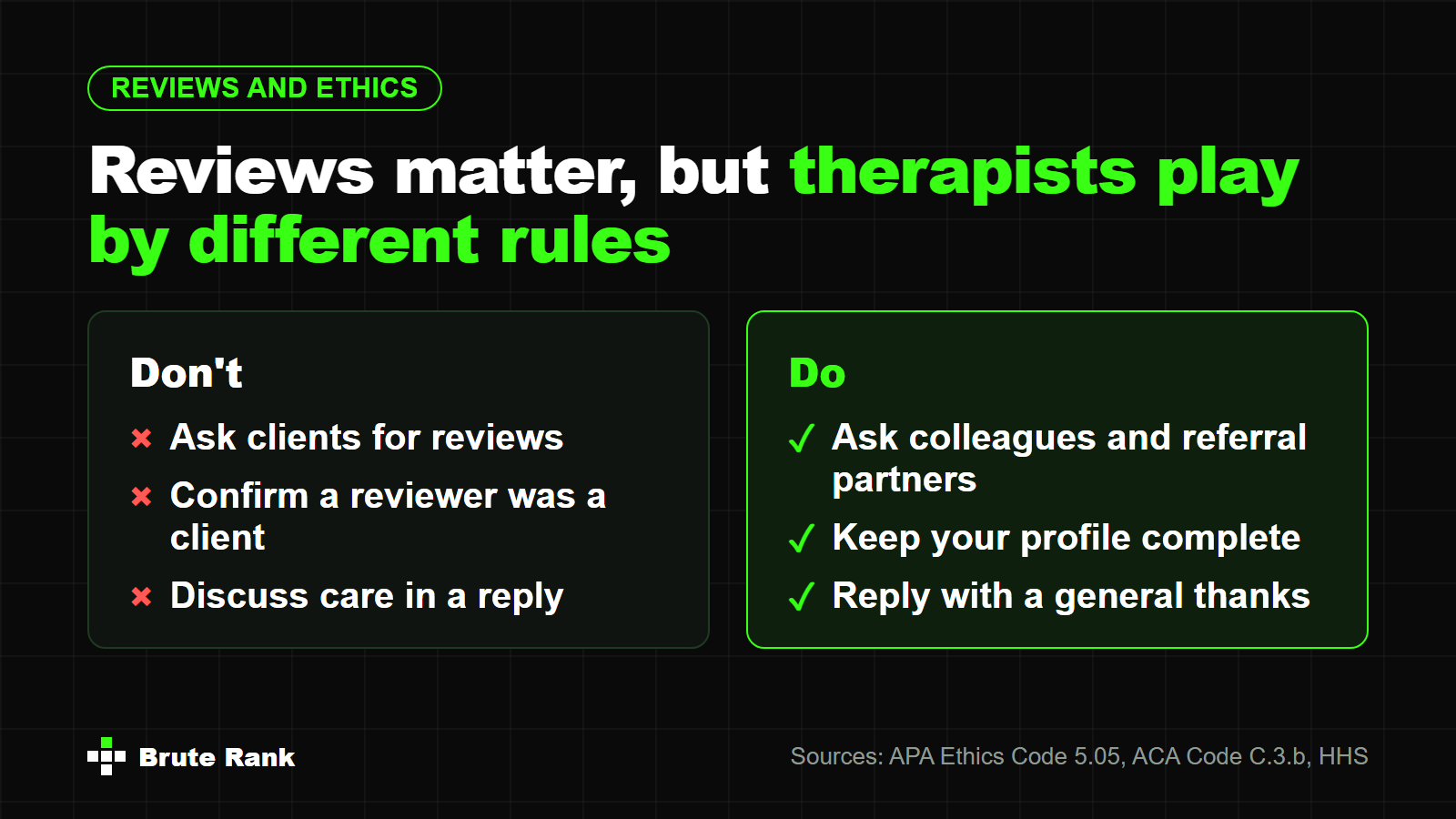
- The APA Ethics Code (Standard 5.05) says psychologists do not solicit testimonials from current therapy clients or others vulnerable to undue influence.
- The ACA Code of Ethics (Standard C.3.b) says counselors who use testimonials do not solicit them from current clients, former clients or anyone vulnerable to undue influence.
- Responding to a review can itself be a HIPAA violation. A California dental practice paid $23,000 to settle an HHS investigation after replying to online reviews with patients’ names and treatment details.
What you can do: make it easy for referral partners and colleagues to review the practice, keep your profile complete, and reply to every review with a general, non-confirming message such as “Thank you for taking the time to share this. We are always glad to hear from the community.” Never confirm that a reviewer was a client, and never discuss care.
Step 3: Build a therapist website Google can understand
Your website is where SEO for therapists is won or lost. Directories rent you visibility. Your website is the asset you own. The most common problem we see is a single “Services” page that lists ten specialties in bullet points. Google cannot rank one page for ten different searches.
The pages every therapy website needs
| Page | Purpose | Target search example |
|---|---|---|
| Home | Who you help, where, and how to start | therapist in [city] |
| One page per specialty | Explain the concern, your approach, what sessions look like | anxiety therapy [city] |
| One page per modality | Explain EMDR, DBT or CBT in plain language | EMDR therapy [city] |
| Clinician bios | Credentials, license, training, who each clinician sees | trauma therapist [name] |
| Fees and insurance | Rates, payers, superbills, sliding scale | therapist that takes [insurer] |
| Location or telehealth | Office details, parking, states you serve online | online therapy [state] |
| FAQ and contact | First session, cancellation, how to book | what to expect in therapy |
On-page basics that still decide rankings
- Title tags: lead with the service and place. “Anxiety Therapy in Austin, TX | Practice Name” beats “Welcome to Our Practice”.
- One clear H1 per page that matches the search: “Trauma Therapy and EMDR in Denver”.
- Plain-language headings that answer real questions: “What does EMDR feel like?” or “How many sessions will I need?”
- Internal links between related pages: your anxiety page should link to your CBT page and the clinicians who treat anxiety.
- A visible next step on every page: phone, booking link or a short contact form.
A note on mission statements: many therapist websites put their mission statement in the most valuable spot on the homepage. Keep it, but move it lower. The top of your homepage should say who you help and where, in the words your clients search. That one change often does more for therapist SEO than any blog post.
Step 4: Technical SEO for therapist websites
Squarespace, Wix, WordPress and practice platforms such as SimplePractice websites can all rank. What matters is how the site is configured. These are the technical checks that matter most for a practice website:
- Mobile first: most people search for a therapist on their phone, often privately. Text must be readable and buttons easy to tap.
- Speed: compress large photos and remove unused plugins and widgets.
- Indexing: connect Google Search Console, submit your sitemap and make sure no important page is set to noindex.
- Structured data: schema markup that states your practice name, address, phone, clinicians and services, so search engines and AI tools read the facts correctly.
- No duplicate city pages: twenty pages that differ only by town name can hurt more than help.
- HIPAA-safe forms and tracking: contact forms should not collect clinical details, and ad pixels or analytics tags should not receive health information. HHS has published guidance on online tracking technologies for HIPAA-covered providers. Parts of it were vacated by a federal court in 2024, so check the current status with your compliance advisor before installing new tracking.
Step 5: Content that builds real authority
Content is where SEO for therapists builds lasting authority: a few topics you know clinically, covered in depth. Mental health falls under what Google calls Your Money or Your Life topics, where it holds pages to its highest standard of trust. That favors therapists. You have something no content farm has: training, licensure and clinical experience. The goal of content is to show it.
Think in topic clusters, not random blog posts
Pick one specialty and cover it completely. For a trauma practice, that might look like this:
- Pillar page: Trauma therapy in [city]: approaches, what to expect and how to start.
- Supporting articles: What happens in a first EMDR session. EMDR vs talk therapy. Signs of complex trauma in adults. How to support a partner with PTSD. Is EMDR covered by insurance?
- Links: every supporting article links to the pillar page, and the pillar links back to each article and to the clinicians who provide the care.
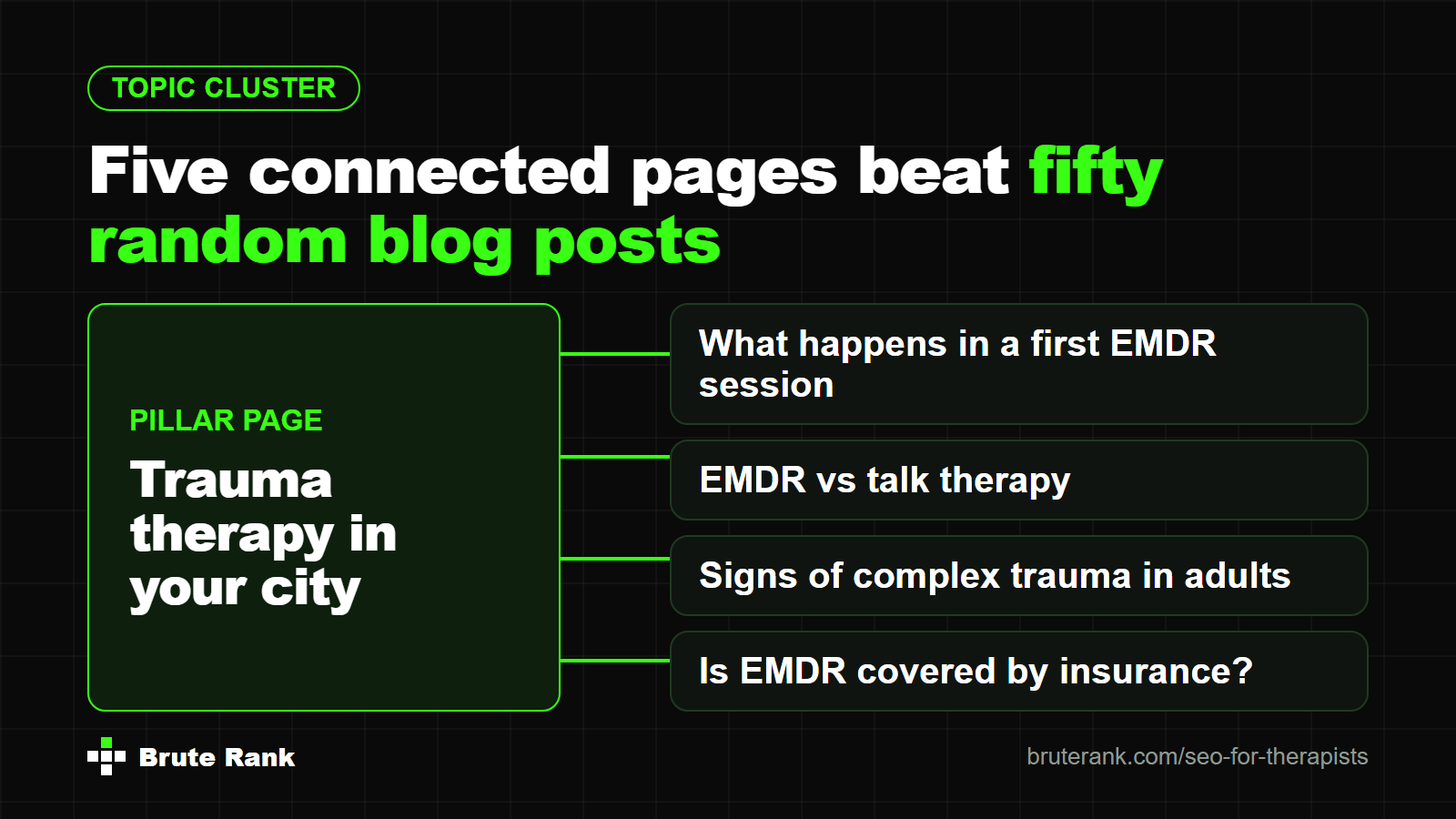
Five strong, connected pages on one specialty build more authority than fifty generic posts about self-care. They also give AI tools a clear picture of what your practice is known for.
Write for AI search, too
AI summaries are changing how people click. A Pew Research Center study of 68,879 real Google searches found users clicked a traditional result in 8% of visits when an AI summary appeared, compared with 15% when none did. Practices that get cited inside those answers keep their visibility. The pages that get cited share a pattern: a direct answer in the first sentence under each heading, specific facts (who you treat, where, how, which insurance), and a named, credentialed author.

SEO for therapists by type of practice
Psychologists
SEO for psychologists works best when it leads with testing and specialties. Psychological and neuropsychological evaluations, ADHD testing and autism assessments are searched with high intent and fewer competitors than general therapy.
Counselors (LPC, LMHC, LCPC)
SEO for counselors is mostly local SEO plus specialty pages. Use the title clients search for, which is usually “counselor” or “therapist”, not your license abbreviation, and explain the credential on your bio page.
Marriage and family therapists
Couples searches are emotional and time-sensitive. Pages for couples therapy, premarital counseling, affair recovery and family therapy each deserve their own URL, with a clear explanation of how the first session works.
Psychiatrists and psychiatric nurse practitioners in private practice
SEO for psychiatrists in private practice should focus on medication management, specific conditions such as ADHD and bipolar disorder, accepted insurance, and whether you offer telepsychiatry in your state. Many searchers are comparing whether they can be seen this month, so availability belongs near the top of the page.
Trauma, eating disorder and other niche specialists
Specialists win by going deep. SEO for trauma therapists or eating disorder therapists means fewer but stronger searches, often from people willing to travel or pay out of network. A complete topic cluster on your specialty can outrank much larger practices.
Online counseling and telehealth practices
SEO for online counseling is different because you have no map pack to win and you can only see clients where you are licensed. Build one page per state you serve, explain licensure and how sessions work, and lean on content and directory profiles for visibility.
Group practices and mental health clinics
Group practices have the most to gain from therapist SEO. Each clinician bio is a ranking opportunity, practitioner profiles can multiply your local visibility, and specialty pages can be written by the clinicians who actually provide that care. If you run a larger program, such as a PHP, IOP or multi-location clinic, our mental health SEO page explains how we approach it.
Psychology Today vs your own website
Keep your directory profiles. They are a referral channel and a trust signal, and for broad searches like “therapist near me” in a large city, a directory will often outrank any single practice. The risk is depending on them. Directory visibility is rented: rules, fees and placements can change without notice, and every profile sits next to dozens of competitors. Your website and Business Profile are the only places where a client sees you alone. The best approach uses both: complete directory profiles that link to your site, and a website that ranks on its own for the specialties you want to grow.
Common SEO mistakes therapists make
- One “Services” page that tries to rank for every specialty.
- Homepages that open with a mission statement instead of who you help and where.
- City pages for towns you do not serve or with copied text.
- Asking current clients for reviews, or replying to reviews in a way that confirms someone was a client.
- Contact forms that ask for symptoms or diagnoses, with ad pixels installed on the same page.
- Stock photos only, with no real faces, office or credentials.
- Changing your phone number or practice name without updating every directory.
How long does SEO for therapists take, and what does it cost?
Google Business Profile improvements and fixes to an existing site can show movement within a few weeks. New specialty pages usually take three to six months to rank well, and longer in competitive cities. Content compounds: the pages you publish this year keep working next year.
Cost depends on what you do yourself. A solo therapist with time and patience can handle most of steps 1 through 3 alone. Group practices and clinics usually hire help, because each clinician, location and specialty multiplies the work. Whatever you choose, avoid anyone who charges per client, guarantees first-page rankings or will not tell you how they build links.
Do it yourself or hire a therapist SEO agency?
Do it yourself if you are a solo clinician, you enjoy writing, and you can give it two to three focused hours a week. Hire help if you run a group practice, you want to grow a specific program, or you have already tried and hit a ceiling. If you do hire, ask these questions first:
- Do you understand HIPAA, the APA or ACA ethics codes, and why I cannot solicit client reviews?
- Will you report booked consultations and intakes, or only rankings and traffic?
- Who owns the website, Business Profile and tracking accounts if we stop working together?
- Will my clinicians review every clinical page before it goes live?
- Can you show real examples of links you have built for healthcare clients?
Your first 30 days: a therapist SEO checklist
- Claim and complete your Google Business Profile, including services, photos and accurate hours.
- Rewrite your homepage title and first heading to say who you help and where.
- Split your services page into one page per specialty you want to grow.
- Add full clinician bios with license, training and the clients each person sees.
- Make your name, address and phone identical across Psychology Today, insurer directories and every other listing.
- Connect Google Search Console and submit your sitemap.
- Remove clinical questions from contact forms and check what your tracking tags collect.
- Publish the first pillar page for your most important specialty.
SEO for therapists: frequently asked questions
Is SEO important for therapists?
Yes, if you want new clients. Most people look for a therapist on Google or in a directory before they call anyone, and they rarely look past the first few options. SEO is how your practice becomes one of them without paying for every click.
Can I do SEO for my private practice myself?
Yes. A complete Google Business Profile, one page per specialty, accurate directory listings and a few strong articles will take most solo practices a long way. Most of the work is clear writing about what you already know.
What keywords should a therapist website use?
Use the words clients use: the concern (anxiety, grief, trauma), the type of help (therapy, counseling, couples counseling), the modality (EMDR, CBT) and your city or state. Put the most important ones in your page titles and headings, then write naturally.
Do therapists need a blog for SEO?
Not a blog in the diary sense. You need a few in-depth articles connected to your specialty pages. Five connected pages on a topic you know deeply beat weekly posts on general wellness.
Does Psychology Today help my SEO?
It helps in two ways: it sends referrals, and a consistent listing confirms your practice details to Google. It does not replace your own website, which is the only place you can rank for your specialty without sitting next to competitors.
How do online-only therapists do local SEO?
Telehealth-only practices are not eligible for a Business Profile with a public address, so they rely on state pages, content and directory profiles. Build one page per state you are licensed in and explain how online sessions work.
How long does SEO for therapists take to work?
Fixes to your Google Business Profile and existing pages can show movement within a few weeks. New specialty pages usually take three to six months to rank well, longer in competitive cities, and they keep bringing in clients for years once they rank.
The bottom line
SEO for therapists is not about gaming Google. It is about saying clearly, in your clients’ words, who you help, where you help them and why they can trust you, then proving it with a complete profile, focused pages and honest content. Start with your Google Business Profile and one specialty page this month. If you run a group practice or mental health program and want a second set of eyes, request a free audit and we will show you where your next clients are searching.
Sources
- American Psychological Association: 2025 Practitioner Pulse Survey
- American Psychological Association: 2024 Practitioner Pulse Survey
- Ahrefs Keywords Explorer, US data, pulled October 14, 2026
- Google Business Profile Help: How to improve your local ranking on Google
- Google Business Profile Help: Guidelines for representing your business on Google
- BrightLocal: Local Consumer Review Survey 2026
- American Psychological Association: Ethical Principles of Psychologists and Code of Conduct
- American Counseling Association: ACA Code of Ethics
- HHS: HIPAA settlement over replies to online reviews
- HHS: Use of online tracking technologies by HIPAA covered entities
- Pew Research Center: Google users are less likely to click on links when an AI summary appears (2025)